
A Field Guide to France's Train Stations: Vibes, Snacks, and Mild Existential Dread
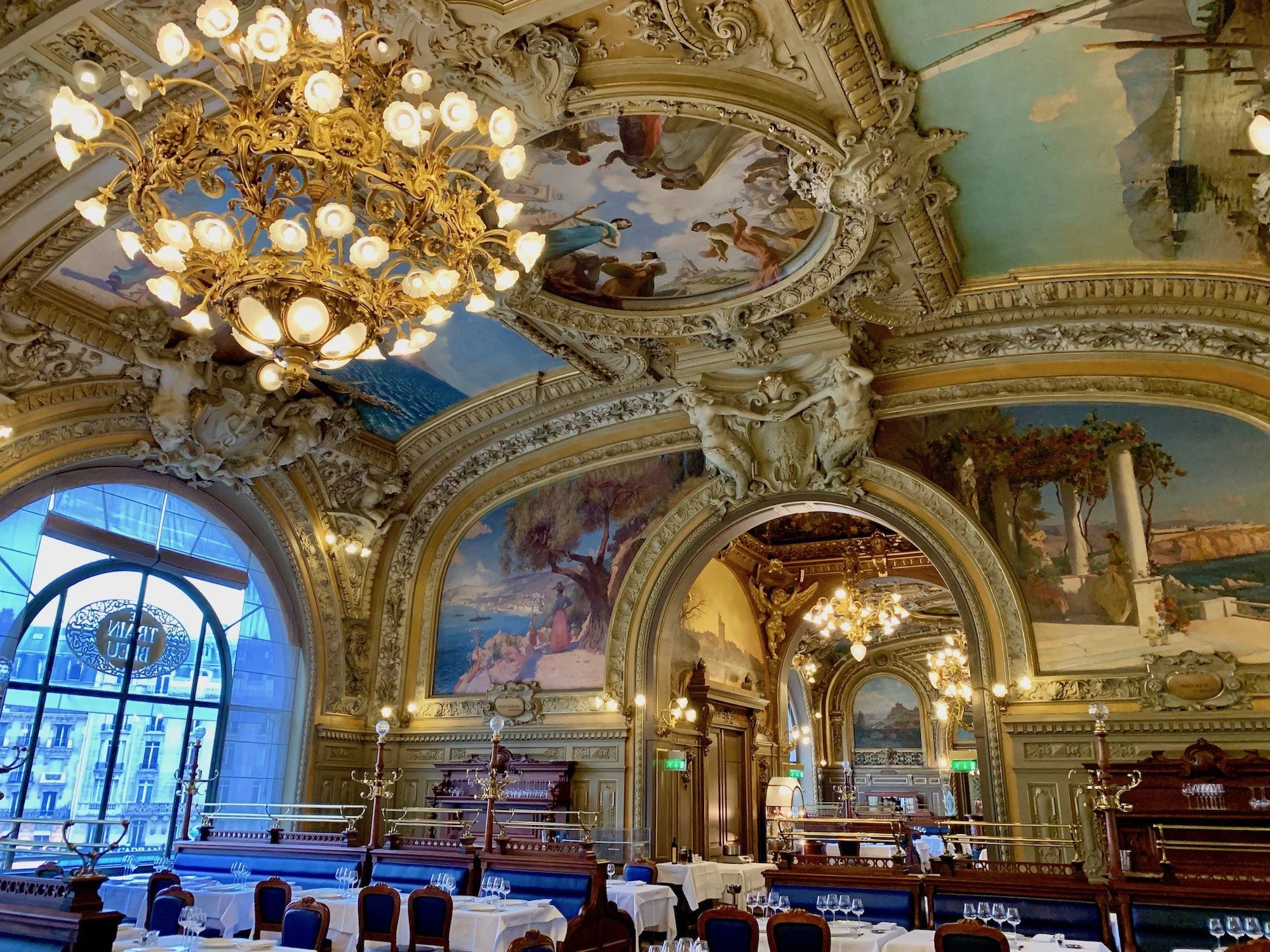
Le Train Bleu, Gare de Lyon, Paris
(7 minute read)
Notes from a frequent rail traveler, from the grand Paris termini to the sleepy country halt with one bad mural.
We take the train whenever a trip allows it, which in France is most of the time, so we have logged a lot of hours in a lot of stations: the cathedral-sized Paris termini, the workhorse hubs, and the tiny rural platforms where you are sometimes the only person waiting. Some are a pleasure to be stranded in. Some are a quiet test of character. Here is the honest read on the ones we pass through, scored loosely on vibes, snacks, and the particular species of dread each one produces.
Paris Gare de Lyon
Our most-used Paris station, because it is the one that sends us home to Burgundy, and the one we would choose to be stuck in over any other. The approach sets the tone: a great clock tower, a plaza that rises gently toward the street, and, more often than not, huge reproductions of whatever is showing at a Paris museum that season. You arrive already in the mood.
It is a big station, so even once your platform, the voie, shows on the board, working out how to get to it can be confusing. Do not panic. The staff in vests know where everything is and speak English, which holds true at every major French station and is worth remembering the moment you feel lost. Our trains almost always go from Hall 2, and the food is better than a rushed traveler expects: the usual Pret a Manger and Relay and coffee counters inside, plus a couple of cafés across the street with terraces if you would rather wait over a drink and watch Paris go by. Upstairs is Le Train Bleu, the gilded belle-époque dining room that looks like a small opera house; we have lingered over tea beneath its painted ceilings, and it lives up to the photographs.
Two honest caveats. The seating is rarely near your platform, so expect to migrate, and when boarding opens the orderly crowd dissolves into a polite stampede at the scanners, because a real line almost never forms. The Metro underneath is a labyrinth of gates that separates careless tourists from their afternoon. But if the railways are going to cost you a day, this is the place to spend it. One winter we missed the very last train out and washed up at the Terminus hotel across the street, which we can report is a fine place to be defeated.
Paris Gare du Nord
The scruffier sibling, and the one we pass through for the Eurostar to London. First impressions run grimy, the surrounding blocks are not the city's prettiest, and the long-running renovations cannot warm the place up fast enough. The food and the waiting are much like anywhere else, and the Eurostar hall, though smaller than you would guess, is calmer than its reputation. It does the job. It just never charms you on the way through.
Lyon Part-Dieu
The most chaotic station we have ever used, and we do not say that lightly. It is a major transfer hub, reliably overcrowded, and we have sat out enough delays in its gray waiting hall to call it what it is: soulless. When boarding starts there is at least the ghost of a line, though it backs up and inches forward, and while the food is the usual cast of characters, you may well end up eating it cross-legged on the floor in a corner. Leave real margin if you are changing here for Marseille, because the place devours time.
What rescues it sits across the street, not inside: a large mall with restaurants, shops, and a cinema that can turn a long layover from an ordeal into an afternoon, plus an easy tram to the airport. Part-Dieu is bearable in exact proportion to how easily you can escape it.
Lyon Perrache
If your destination is Lyon itself, this is the one to get off at, even if it means riding a few extra minutes past Part-Dieu. You will often be the only person stepping down, so there is no crush, and you land right in the heart of the city, a short walk from the Confluence. The station is modest for now. It is deep into a years-long overhaul, the Ouvrons Perrache project, that eventually promises to open the building up to the city and add a rooftop garden, though that is a good way off yet. You come here for the location, and the location is worth it.
Marseille Saint-Charles
Beautiful, and it makes you earn the beauty with a grand staircase that is a joy to walk down and a punishment to climb when you are late. Step out the top, though, and Marseille opens up beneath you, all sea air and southern light; time it for sunset and it is one of the great arrivals in France. Inside is a little rough around the edges, but in Marseille that reads as character rather than neglect. A favorite of ours, easily.
Dijon
Dijon-Ville is one of the more pleasant places in the country to catch a train. There is plenty to eat and drink, a public piano in one of the halls for the bold, a short walk to Place Darcy, and a botanical garden right next door if you have a wait to fill. It asks very little of you and rewards you anyway.
Bordeaux Saint-Jean
It sits near the Garonne, close to the center, wrapped in handsome French station architecture that photographs well and holds up in person. It was calm when we came through, though the fast line to Paris has surely filled it out since. A strong first impression, lightly held.
Pau
Pau station sits down in the river valley, some thirty meters below the old town, and on an ordinary day a little funicular carries you and your bags up to the Boulevard des Pyrénées and the streets around the château. Simple, charming, and free.
The day we came was not ordinary. The Tour de France was passing through, on the hundredth anniversary of the yellow jersey, with the President of the Republic in town, and the funicular had been shut for security. So instead of gliding up the hillside, we hauled our luggage up it, one flight of stairs at a time. Lovely little station. Catastrophic timing.
The small stations
Pulling into a small country halt does not feel like travel. It feels like coming home. These are the stations of ordinary regional life, of the TER, and they share a certain character: sometimes staffed and sometimes not, the platform murals uniformly grim, and every so often so silent that you are the only soul standing there, which is stranger than it sounds.
They are also where the warmest moments happen. One tight connection had our first train running late, and rather than let us miss the next one, a staff member met us on the platform and ran with us, down through the tunnel under the tracks and up the other side, all of us laughing and out of breath by the time we made it. These are the platforms where you meet a friend as they step off the train, or stand waving as one pulls away. The one we use most is the Le Creusot TGV station, among the more important rural stops in the country and our own door onto the high-speed network: not large, but perfectly nice, with a car-rental desk and a Relay for whatever you forgot.
How to survive any of them
It comes down to a single question the moment a delay appears: can you leave? An hour lost at Gare de Lyon is an hour among cafés and macarons. An hour lost at Part-Dieu is only survivable if the mall across the street is open and you know how long you are stuck, which on the railways you rarely do. So pad the chaotic ones with extra time, arrive early anywhere with border-style security like the Eurostar, and lean on the staff in vests, who speak English and have saved us more than once. Beyond that, the whole thing improves the instant you have a snack in hand and decide you are an anthropologist studying a fascinating species rather than a passenger with a schedule to keep.
This is not all of France, of course. We have been to Toulouse, Strasbourg, Nice, and plenty of others, but never by train, so their stations will turn up here another day.
Want to see it in person?
We're planning My Life in Burgundy, a small-group journey for up to 14 guests through the churches, vineyards, and tables of southern Burgundy. Join the waitlist to hear first when details are ready. No payment, no commitment.
See My Life in Burgundy