
The Two Weeks Burgundy Goes to Work
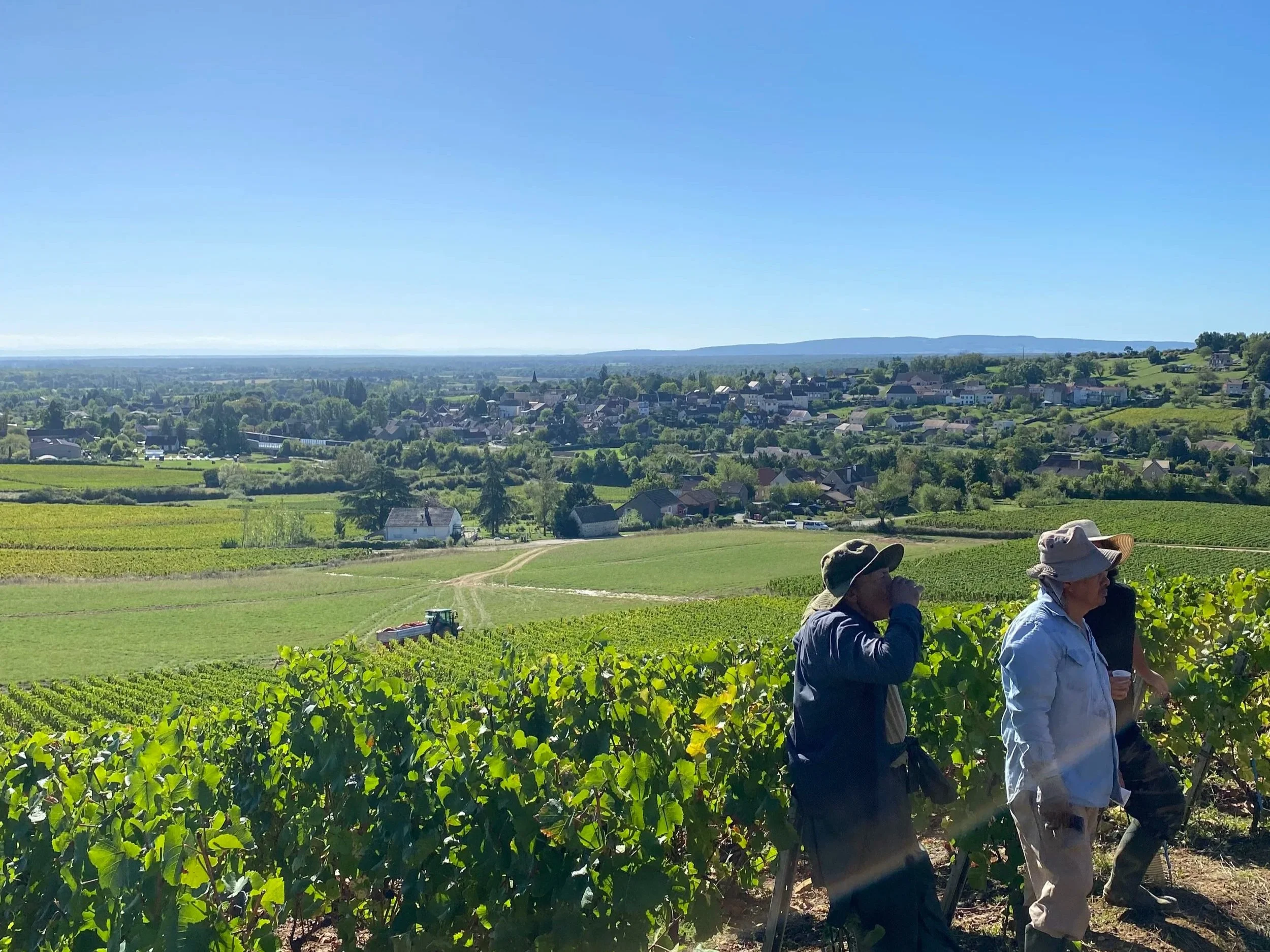
Coffee break
(9 minute read)
Ask a Burgundian grower in July when the harvest will be and you will get a range. Ask in the middle of August and you will get a week. The exact day is decided a few days out, after somebody has walked the rows, eaten the grapes, and run the numbers on sugar and acid, and once it is decided the whole region rearranges itself around it. Crews that have been on call for weeks get their phone call. Kitchens get stocked. People take days off from other jobs. Then it starts, and it does not stop until it is finished.
That is the part visitors tend to miss. The vendange, the grape harvest, is not an event Burgundy stages. It is the two or three weeks when Burgundy stops being a wine region in the pleasant sense, the one with tasting rooms and stone villages and a view, and becomes a farm working against the clock. Everything in the bottle you will eventually buy is decided in that window.
In 2025 Paul and I worked one. We picked for Domaine Michel Goubard et Fils in Givry, where we buy most of our red wine. We saw the call for pickers on their Facebook page and applied in person while we were there buying a case. It was paid work, seven days in the vines across late August and early September, with one day lost to storms.
The work is simple, which is not the same as easy
You get two tools. Clippers and a bucket.
You cut bunches, you drop them in the bucket, and when the bucket is full you empty it into the hod on the porter's back. He walks it down to the truck and comes back, and it goes on like that. The one rule that takes a minute to absorb is that you leave anything growing off the small side shoots rather than the main branch. Those bunches never got enough of what the vine had to give. The rows are pruned meticulously every year so the plant spends itself on the fruit that counts.
What makes it hard is geometry and time. You are bent over, and you are bent over on a slope, so you are climbing and folding at once for four hours, breaking for lunch, then doing it again for four more. It rained most of the days we worked, which meant mud that was either slick underfoot or stuck to our boots in growing slabs. Paul said we were getting taller with every step.
Nobody tells you to hurry. Everyone takes a row, lines up at the end of it, and starts at the same moment, so your position relative to everyone else is a matter of public record all morning. Whoever finishes first turns around and works back toward the people who have not. That is the whole system, and you understand inside an hour that you are supposed to be fast. It is also why people cut themselves. We both clipped our own fingers, repeatedly, as did everyone. On the fifth day Paul cut his badly enough to need urgent care, which cost him a day and got him back for the last one.
After the first afternoon our backs were finished. The seasoned pickers told us to buy paracetamol and take it on a schedule. In France it lives behind the counter and you are usually handed one small box, but ours heard the word vendange and sent us out with as much as we wanted. She had clearly had the conversation before.
Why a person and not a machine
Machines pick a great deal of Burgundy and do it well. What they cannot do is choose.
A premier cru is picked by hand because a hand belongs to somebody who is looking at the bunch. That is a quality decision, made before the fruit ever reaches the cellar, and it is inseparable from the way this region thinks about wine. Burgundy sorts its wine by where it came from, in finer and finer increments, down to individual parcels with their own names. That is not unique to Burgundy. All of France does it: Côte Chalonnaise means near Chalon, Côte de Beaune means by Beaune. Burgundy does it with an obsessiveness nobody else has matched, across 84 appellations and more than 560 named premier cru climats.
You do not have to pick grapes to understand any of that. It is on the label, and an afternoon with a good map will teach you more than a week with clippers.
What the week teaches is the cost. Somebody was in that row, on a hill, in the rain, moving fast because the sugar does not wait, and the difference between a wine that carries a parcel's name and one that does not is partly a decision made with sore hands at four in the afternoon.
Lunch is not a break
Here is the part that surprised us most, and the part that is most French.
Coffee was waiting when we arrived at half past seven. Croissants came out mid-morning. At noon everyone went back to the winery and sat down at one long table to a real meal: a meat, a vegetable, a starch, a salad, and plenty of wine. Not a sandwich in a truck. A proper lunch, unhurried, with the people you had been working beside all morning. Then everyone got up and went back out, which after that much food and wine is its own act of will. A nap would have made more sense. Nobody napped.
At the end of the day we all had a beer before driving home.
None of this is a perk. It is the shape of the day, and it is why a crew of strangers becomes something else by the third afternoon. My French was good enough for instructions and questions and not much beyond, so I did more listening than talking, and I still came away knowing who was funny, who smoked too much, and who should be kept away from the beans.
The last shovelful
A week or so after the picking ended, everyone came back for the paulée.
The word comes from the local term for a shovel, the last shovelful of grapes tipped into the press, or perhaps from poêle, the pan the meal was once cooked in. It means the same thing either way. The picking is done, and the people who did it sit down to eat.
Ours ran from evening into the small hours, course after course, with Pierre-François pouring wines from the nineties and the early 2000s himself. Every estate in Burgundy has some version of this. The famous one, the Paulée de Meursault, has drifted into November and become part of Les Trois Glorieuses, a grand lunch for seven hundred. The one at the domaine, held for the crew that brought the fruit in, is the older and plainer article, and it happens at estates all over the region every autumn with no outsider present.
If you are in Burgundy while it is happening
Then this is the one time of year I would steer you away from the producer.
Having the grower pour their own wine for you, with the pride that comes with it, is the best thing you can do in this region, and for fifty weeks of the year it is exactly what I would tell you to do. During the vendange, that person is in the vines or at the sorting table and cannot stop. Some estates will still receive you. I would not plan on it. A cave or a village co-op is the smarter call for those two weeks, and you can taste widely and well at either without asking somebody to walk away from a crop they get one shot at.
Some estates now sell a morning in the vines as a visitor experience, and the rules that made it legal in France are specific about what it can be: a paid discovery activity, on a small marked patch, of no use to the harvest itself. That is not a loophole, it is the point. Nobody hands a real row to a stranger in the week the year depends on. As a way to see how it works, it is a reasonable morning.
Time your expectations, too. Harvest dates have been recorded here since 1354, one of the longest such records anywhere, and they have been moving. 2003 was the first year picking crossed into August at all. In 2026 the first grapes came off at Le Montrachet on August 13, beating a record that had stood since August 15, 1556. Arrive in the third week of September expecting to see picking and you may find the tanks already full.
What you will find is September, which is the best argument for the month anyway. The heat breaks, the vineyards start turning, and on the third weekend the Journées du Patrimoine open Romanesque churches and private châteaux that are shut the rest of the year.
We didn’t go back this year. We were too busy, and it was hard on the body in a way we both felt for a week afterward. I loved it anyway, and I got to follow the fruit all the way from the row to the vat, our sweat and blood (mostly Paul’s) going in with it.
The 2025 Givry premier cru La Grande Berge has not been released yet. When it is, I will buy several cases, and it will not be for the vintage.
Have you ever been somewhere while it was working rather than hosting? Tell us what you saw, and whether it changed what you thought you were looking at.