
Southern Burgundy: The Churches, the Chardonnay, and the Charolais.
(17 minute read)
Drive south out of Beaune and the Burgundy you were sold runs out in about forty minutes.
The grand cru signposts stop. So do the tasting rooms with the English menus. What comes next is hills, limestone, and white cattle standing around in green fields as if someone with a good eye had placed them there. Most people read that as the end of the region. It's the beginning of a different one, and it's the one Paul's family is from.
Southern Burgundy is, more or less, the department of Saône-et-Loire: Mâcon at the bottom, Chalon at the top, the Charolais and Brionnais rolling west toward the Loire, and the Bresse spreading east toward the Jura. It has one of the densest concentrations of Romanesque architecture in France, white wine that goes toe to toe with the Côte d'Or at a third of the price, and beef that the rest of the country eats. What it doesn't have is a famous town telling you to come.
We live here, in a village of 269 people where the church bell is the loudest thing that happens all day. It is cheaper down here, though that isn't the reason to come. The bigger reason is that what survived here survived unedited.
What Is Down Here
Five landscapes sit shoulder to shoulder, none of them more than an hour apart. The Clunisois is the country around Cluny, wooded and rolling and thick with villages built of a pale gold stone that makes the whole area look lit from within around six in the evening. South of it, the Mâconnais is vineyard end to end, broken by two limestone escarpments, the Roche de Solutré and the Roche de Vergisson, that rise out of the vines as if something shouldered them up from underneath. North of Cluny, the Côte Chalonnaise picks the wine back up around Givry, Mercurey, Rully, and Buxy. West is cattle country, the Charolais and the Brionnais, green and quiet and scattered with churches, and east of the Saône, the Bresse is flat and watery and belongs to the chickens.
The drives between the places you'd want to see run about forty-five minutes. Nothing here is far from anything, but nothing is walkable from anything either. What that adds up to is a trip made of short drives and long lunches, where the plan for the day is three villages and the third one turns out to be the one you remember.
Two towns in the middle of all this look nothing like the rest. Le Creusot and Montceau-les-Mines were coal and steel. The last underground mine closed in 1992 and the last open pit in 2000, and the steel had already taken its beating by then. Le Creusot still forges steel, including parts for the nuclear fleet and for trains, so it's no ruin. Still, outside wine and farming the economy here is thin, and you'll notice it: a restaurant scene thinner than Beaune's, and nothing priced for tourists. Nobody is performing for you. That's the whole appeal, and it's also why it's fragile.
The Stone
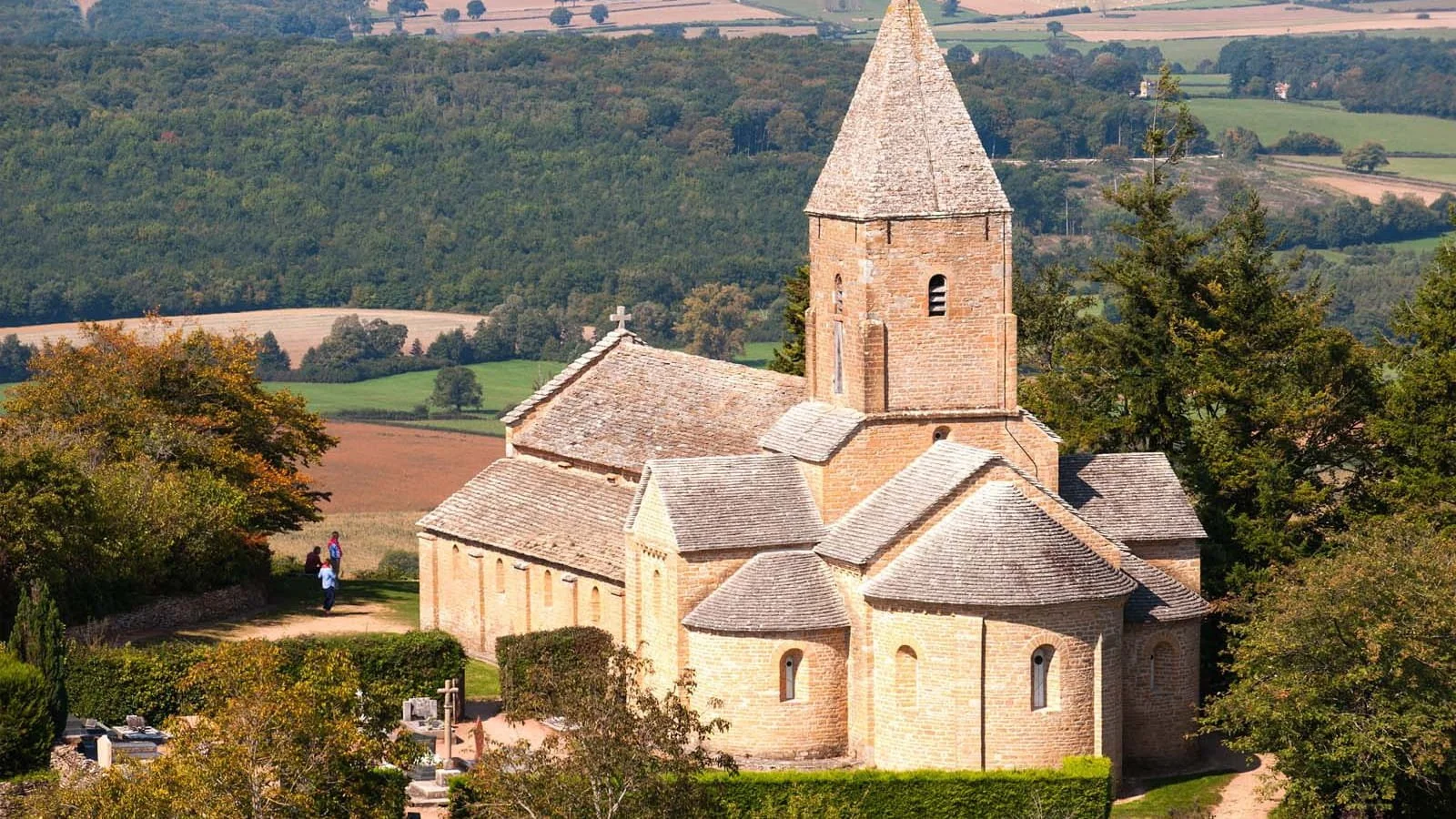
Saône-et-Loire holds something on the order of 250 Romanesque buildings. More than a hundred are in the Charolais-Brionnais alone, strung along a signed driving route called Les Chemins du Roman (the Romanesque Roads). Here the eleventh century is ordinary building stock, sitting at the end of farm tracks and holding up the middle of small villages.
The reason is Cluny. Founded in 910 and answerable to nobody but the pope, the abbey built a centralized network of priories across Europe, something on the order of 1,400 houses at its height. Its church was the largest in Christendom until St. Peter's in Rome was rebuilt to beat it. For two hundred years, money, masons, and one very persuasive architectural idea radiated out of this valley, and the village churches soaked up all three. Then Gothic architecture arrived, pointed arches and height and light, and the rebuilding that swallowed early stone everywhere else mostly left these hills alone.
Cluny itself is a wreck, and you should still go. After the Revolution the abbey was sold off as national property and quarried, methodically, until 1823, which means the town used the largest church in Christendom as a hardware store for a quarter of a century. Roughly a tenth of it is left.
What your ticket buys is comprehension, and Cluny comes at it from every angle. You stand under the surviving transept arm and look up at a vault that's already absurdly high, and above it is a tower that's higher still and wasn't even the tallest one. The outline of the vanished nave is marked on the ground, and it runs much farther than seems reasonable. The museum is excellent, and its scale model and virtual reconstructions put the roof back on. Then you head into the medieval town, which is intact and worth an afternoon on its own, and start noticing the abbey's stone in the walls of people's houses.
For the shape of what was lost, go west to Paray-le-Monial. The basilica there is Cluny in miniature, and complete: three naves instead of five, one transept instead of two, but the same logic and the same cascade of roofs stepping down the east end, which will stop you in the parking lot. It's the most visited building in the department, and deservedly so. A new grand organ was inaugurated there in May 2026, so go hear it in that room.
Then Tournus, where Saint-Philibert is among the oldest Romanesque buildings in France and looks, from the street, like something built to survive a siege: heavy walls, almost no windows, arrow slits. You walk into a low, dark narthex full of enormous round columns, then step through into a nave that's bright and tall and roofed with barrel vaults laid crosswise, a solution you'll hardly see anywhere else. The whole experience lives in the ninety seconds between those two rooms.
Those three are what you came for. The village churches are what you'll talk about later.
Vézelay, two hours north, was restored by Eugène Viollet-le-Duc starting in 1840, and he restored it toward his idea of what it should have been. In the nave, he took out three Gothic vaults to manufacture a Romanesque unity with no physical evidence behind it. In 1850 he had the sculptor Michel Pascal carve seven new capitals to replace damaged medieval ones, and one of them, the Judith capital, brought in subject matter that flattered a nineteenth-century political reading of the place. The result is magnificent. It's also, in part, one nineteenth-century man's opinion in stone, and Paul's word for him is fantasist.
Down here, nobody could afford an opinion. The churches got patched, propped, and left alone, and when someone did intervene, it was usually to keep the rain out. The twelfth-century priory at Le Puley had its bell tower collapse onto it in 1877, and what stands now is a fragment held together by later hands, some of them family: Paul's mother and aunts worked on its partial repair in the early 1970s. Saint-Gengoux-le-National, begun in 1120 by the Benedictines of Cluny, shows both what it started as and what came later, a three-story octagonal Romanesque bell tower standing beside Gothic work that nobody thought to tidy away. That's the texture of the whole region: protection rather than embellishment.
What happens here instead is discovery. The murals at the Chapelle des Moines, the Cluniac chapel at Berzé-la-Ville, began coming out from under the plaster in 1887. The big wall paintings at Gourdon were brought back to light in 1971, a reminder that even a modest country church once had its choir and apse painted top to bottom. There's a fair chance something is still under the plaster in a village you'll drive through without slowing down.
In fairness, there are exceptions. Autun is in this department, and Viollet-le-Duc worked on its tympanum too. That tympanum, Gislebertus's Last Judgment, is one of the great works of Romanesque sculpture anywhere, and it survived by accident. In 1766 the canons decided it was primitive and offensive and plastered it over, so when the Revolution came through smashing religious sculpture, it found a blank wall and moved on. The insult is what saved it. Go stand in front of it. Autun is the reminder that the big monuments here got the same nineteenth-century attention as anywhere else. It's the village churches that were left alone.
And the small churches are open. In over two years of driving out to them, I have never once found a locked door. You push, it gives, and you're alone in the eleventh century with a light switch on a timer and nobody selling you anything.
I haven't run into one myself, but I'm told a handful are shown only through a grille or ask you to fetch the key from the town hall, so check first if you're driving an hour for one specific building. Otherwise, park, walk in, and sit for a while. None of it takes more than twenty minutes, which is how you end up having seen six churches before lunch without feeling like you did anything at all.
The Wine
The Mâconnais is Chardonnay country, and it deserves a full day rather than a stop.
Pouilly-Fuissé is the name people know, made in four communes beneath the rocks of Solutré and Vergisson, and we love it. It isn't the bargain it was five years ago, though. In 2020, twenty-two climats (named vineyard plots) were raised to premier cru after a long campaign, and prices followed, pulling the village-level bottles up with them. A few producers also lean hard on the barrel, so taste before you commit to a case.
Saint-Véran is our other favorite. The short version of the difference is that Saint-Véran is fresh, lively, and easy to like, while Pouilly-Fuissé is the richer, rounder, more elegant of the two. Saint-Véran wraps around Pouilly-Fuissé on almost the same limestone and costs less, which makes it the sensible place to start and, on a lot of tables, the place to stay.
North, in the Côte Chalonnaise, the reds arrive. Givry is about the best village in Burgundy for good-value Pinot Noir and has somehow dodged the pricing that swallowed everything else. Mercurey is the big one and the serious one, with more structure than the rest, and a good bottle will sit happily for a decade. Rully does whites and crémant. Montagny is white only, and the cooperative at Buxy handles something like 60 percent of it, which is unusual in a region that mostly insists on doing everything alone.
Buy at the domaine, the estate that made the wine, whenever you can. Wine shops are good and useful, but going direct puts you in front of the person who made the thing, who is proud of it and glad to pour it and tell you how it got that way. A domaine can also open more of its own bottles than a caviste (wine merchant) can afford to keep open at once. The price is usually a little kinder, and the money goes to the person who made the wine, which is where we'd rather it went.
They may not speak English, and that's fine. Someone is there to pour you a taste, take your money, and help you get the boxes into the trunk, and none of that needs much language. Learn one word before you go, dégustation (tasting), and you have everything you need. Once we turned up to find the door locked and a phone number handwritten on it. We called it, and a man walked over from another building where he'd been busy with something, opened up, poured for us, sold us wine, and went back to work. That's the level of formality involved.
We buy our reds in Givry and our whites in the Mâconnais. The last Givry we carried out of a cellar door was eighteen euros, which is on the high side of average for Burgundy. You'll often pay less, and occasionally more, and be glad.
The Table
The Charolais is its own reason to come. The breed is from here, the cattle are in the fields you just drove past, and the beef on your plate didn't travel to reach you. The line from field to table is about as short as it gets in France.
Then there are the goats, and two of their cheeses have their own appellation. Charolais is one of the largest goat cheeses in France, a fat barrel of raw milk made within sixty kilometers (about thirty-seven miles) of Charolles, fine and smooth inside in a way that has no business coming out of something that size. Mâconnais is the opposite, a featherweight you could hide in your palm, salted on one side and never turned.
The Mâconnais cheese exists because the vignerons (winegrowers) kept a few goats to manure the vines and eat the hedges, and their wives made cheese from what the goats gave back. That meant wine and cheese off the same farm, for centuries, for entirely practical reasons. Eat both cheeses young, when they're fresh and lactic and taste like cream, then eat them again after three weeks, when they've gone firm and nutty and faintly blue at the edges. They're not the same cheese twice.
Gougères, the warm cheese puffs, are the regional standard and will turn up as an apéritif. Frogs' legs appear more often than Americans expect and taste better than Americans expect. They come one of two ways, sautéed in garlic, butter, and herbs, or in a cream sauce. I can only speak for the garlic, and it's very hard to stop eating.
Escargots turn up on menus all over France, and the preparation everyone knows comes from here: à la bourguignonne, in the shell under garlic and parsley butter. The snail carries the region's name too, the escargot de Bourgogne, and it does live in these hedges and vineyards, though it has been protected in France since 1979, so most of what reaches a plate was gathered elsewhere.
If you come in the fall, look for truffe de Bourgogne (Burgundy truffle) on menus. It's a different species from the famous black truffle of the Périgord, browner in the flesh and more about hazelnut and damp woods, and the season runs roughly from September into December. The big market for it is north of here at Noyers-sur-Serein, but it turns up on tables all over Burgundy while it lasts.
The chicken belongs to the Bresse, the flat country east of the Saône around Louhans. Volaille de Bresse (Bresse poultry) has held an appellation since 1957, the only chicken in the world that does, and Louhans runs one of the oldest and largest markets in France on Monday mornings under its medieval arcades.
Wherever you end up, a market town is no more than fifteen minutes away by car. The spacing is older than cars: the markets grew up close enough together that a farmer could walk his goods in and still get home the same day, and they are still where they were. Ours is Saint-Gengoux-le-National. Find out which day the nearest one runs and give it a morning.
Where to Stay
Pick one base. The triangle of Mâcon, Tournus, and Cluny puts you inside the wine and the Romanesque, and within a short drive of most of what you came for. A region this size doesn't justify changing hotels, and every move costs half a day and a good mood.
The full range is here: ordinary hotels, château hotels, chambres d'hôtes (bed-and-breakfasts), gîtes (vacation rentals), and a fair number of restored farmhouses that don't fit any of those words. From what we've looked at, premium rooms run roughly 100 to 200 euros a night, with luxury above that and perfectly good rooms below. There isn't much lodging in any single village, so the good places go early.
The charm and the difficulty here come from the same place: uneven stone floors, a step at every church door, cobbled lanes, and farmhouse conversions that have no elevator and never will. If someone in your group has a mobility issue, none of this rules the trip out, but it has to shape the lodging choice rather than be discovered on arrival.
How Long, and When
Five or six nights is the right answer for most people: a day for the stone, a day in the Mâconnais, a day for a market and a long lunch with nothing scheduled after it, and one or two more for whatever those days turn up. That's also close to the shape of the small-group week we're building here. Three nights is the floor. It works, though we suspect you'll spend the drive home listing what you missed. Two weeks isn't too much, but somewhere in the second week you stop visiting and start living here, which is a fine thing to do and a different conversation.
Come in May or September. The weather in those two months is the best the region gets, warm without the heat and dry without the dust, and nothing else here comes close.
There are two things to plan around, neither of them a reason to pick different dates. May is stacked with French public holidays, and when one falls midweek people take the days around it too, so a Tuesday can turn out to be closed. Check the calendar before you build a day around one specific restaurant or museum. In September, the vendange (grape harvest) has been creeping earlier and can be over before the month starts. If your dates land in it, the domaines will be out in the vines, and a drop-in tasting is a lot to ask.
February is the one to avoid: cold, wet, gray, and gray again. August is the other, for a different reason. Much of France takes the month off, including the family-run restaurants, bakeries, and shops you came here for, which close for two or three weeks and put a handwritten sign on the door.
Getting Here
Take the train. Le Creusot TGV sits on the Paris to Lyon high-speed line, an hour and twenty minutes from Paris Gare de Lyon and forty minutes from Lyon. Mâcon-Loché TGV, farther south on the same line, is the better door if you're staying near Mâcon or Cluny. Flying into Lyon works, and so does driving down from Paris, but the train is cheaper, lighter on the planet, and usually faster once you count everything you do at an airport that isn't flying.
Then get a car. If you want the churches and the domaines, which sit up farm roads, this isn't negotiable. The regional TER trains along the Saône are fine for what they are, and there's real pleasure in riding one to a village and walking around it for the afternoon, but they won't take you to the good stuff.
And bring some French. Most people you meet will not speak English. Everyone here studied it for six years at school, so some will surprise you and meet you halfway with visible goodwill, but it is not something to plan around. Get a translation app, learn enough to say hello properly, and practice your pointing finger on the menu. People respond to the effort, not to how well you pull it off.
What People Get Wrong
Most people picture wine and cows, and treat the whole department as the agricultural filler between Beaune and Lyon, something you drive through on the way to somewhere with a name.
Three days in, nobody says that. What they say is that the culture runs much deeper than they expected, that there's something in how people here hold onto the ground they work that they can't quite name, and that the landscape got to them in a way the famous ones didn't, because it never once tried.
The stone is a thousand years old and nobody improved it. The Chardonnay is world-class and the cellar door is standing open. And the whole thing is just south of the part everybody photographs.
Have you spent time in Saône-et-Loire, or driven straight through it on the way somewhere louder? Tell us what you found. Or tell us we're overselling the place we happen to live, and make the case for Beaune. We'll take both.