
Knocking on a Winemaker’s Door: Tasting and Buying Wine in Burgundy
My girlfriend at the time needed wine for a friend, so we drove to Goubard, my usual domaine in Givry. It was closed, which it had no business being on that day. So I tried the other name I knew in the village: Lemonde. Pascal Lemonde is an old, well-regarded domaine in Givry, and I knew it the way you know a name off a label, which is to say by surname only.
I looked it up, we drove over, and the address turned out to be a house. Not a cellar with a sign out front, just somebody's home, and we sat outside wondering whether we'd gotten it wrong. We would probably have left if a man I'd worked the vendange (grape harvest) with hadn't been standing there. He told us we were in the right place, and he ended up spending the evening with us.
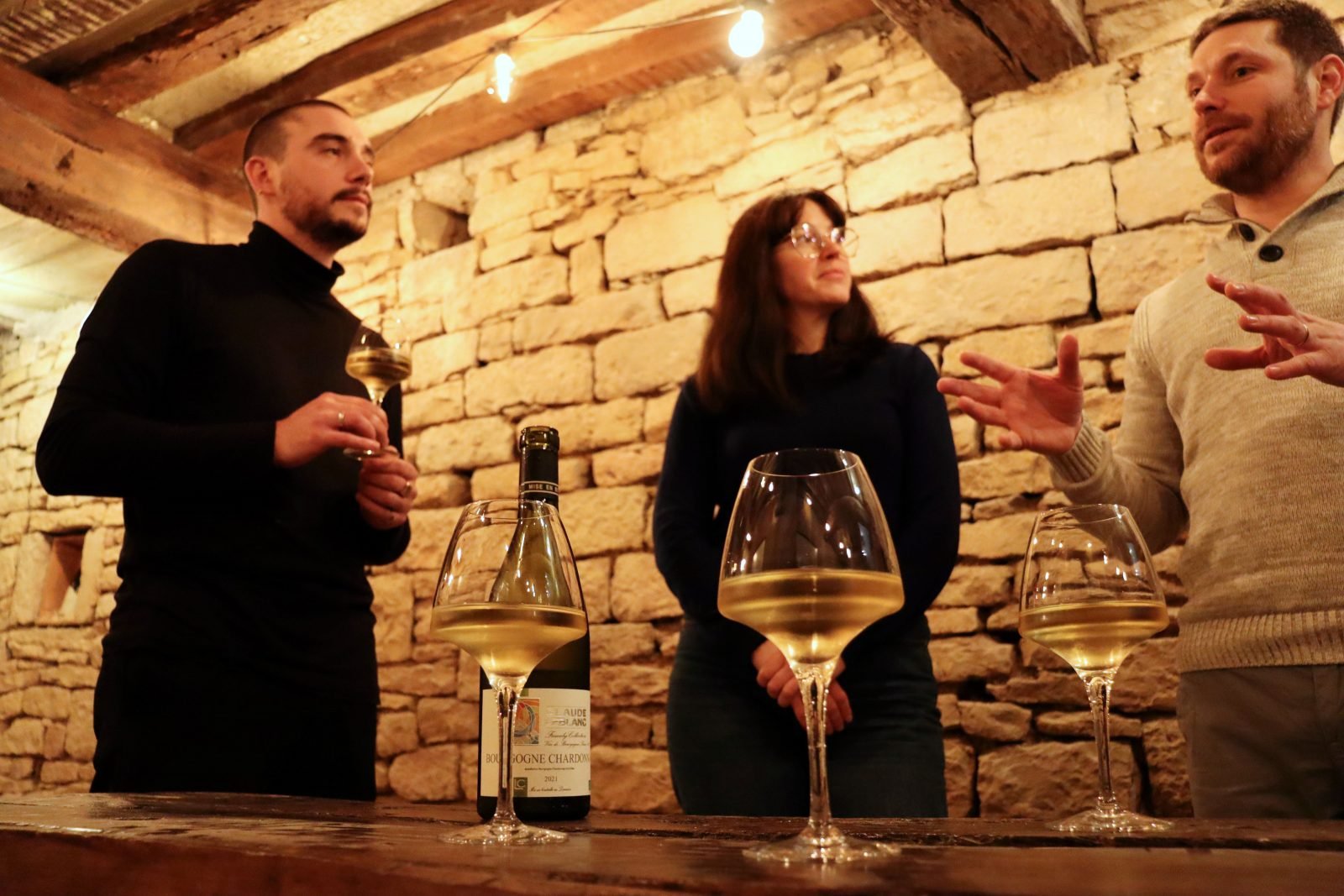
The house belonged not to Pascal but to Vincent Lemonde, of the same family, who had only recently started selling wine under his own name. He was glad to have us, and it showed. He gave us a full tasting, put out pâté, took us down through his cave (cellar), and opened every wine he makes. We were there for hours. We left with at least two cases, and the cheapest bottle among them was 13 euros, less than we'd have paid for anything comparable elsewhere, and very good.
Most visits do not run to hours. But the way it works is much the same at every cellar door, and it helps to know before you knock.
Start with the appellation, then trust the map
Burgundy sorts its wine by village, so it helps to set out with a few appellations in mind, since the village on the label is the one you'll be driving to. What no map can tell you is whether a particular domaine is any good, and the only real test is a glass. There is one small warning sign worth knowing, though. A bottle labeled Vin de France carries no regional appellation at all, which means its grapes, or the wine itself, can come from anywhere in the country. Nothing wrong with that in principle, but it's the opposite of what you came to one of the world's most famous wine regions to find, and it’s a bit of a red flag for a domaine to have it on the menu.
Most of the new places we've found came from searching Google Maps in whichever appellation we happened to be driving through. If the pin leads to a house, as it did with Vincent, keep going. Plenty of growers live where they work and receive visitors in a tasting room off the side of the building. Domaine Vervier in Solutré-Pouilly, where Cindy and Jérémy Vervier make some of our favorite Mâconnais whites, is their home as well.
Call ahead, or mind the hours
It's polite to ring ahead at a domaine you don't know, and the call will be in French. If your French won't carry a phone conversation, there's no harm in calling and hoping for English, or in simply going during the posted hours and taking your chances that someone is free.
Hours vary, but the pattern we run into most is roughly 8 to noon and 2 to 6, with Saturdays usually open and Sundays usually not. The lunch break is observed with real conviction, so a 12:15 arrival tends to meet a locked door.
Two things will cool your welcome. The first is walking in without a bonjour, which in France is how you acknowledge there's a person in the room. The second is showing up during the vendange, the grape harvest, which usually falls somewhere between mid-August and mid-September. For those weeks the people you came to see are in the vines from morning until night. We've written about what the harvest looks like from the inside, and the short version is that it's the wrong moment to ask someone to pour.
What happens once you're inside
At a small domaine, the person pouring is usually the person who made the wine, and that's what sets it apart from a tasting room back home. You work through the list one bottle at a time, a spout fitted to each as it's opened and a bucket somewhere within reach, while they tell you where the vines grow, how long the wine spent in barrel, what kind of barrel, and whatever else they think you ought to know. They're glad to answer questions, and they'll keep talking for as long as you're interested. Once it's clear your French won't stretch that far, they'll generally switch to whatever English they have, and the wine does a fair share of the explaining anyway.
Yes, people spit, straight into the bucket. More often they swallow what's in their mouth and tip the rest of the glass into the bucket, which is the polite middle ground. If you're driving, spitting is completely normal, and worth doing. France's drink-driving limit is lower than in most of the US, and a morning of small pours will get you there sooner than you'd think. Practice over the sink at home first. A tasting room is a poor place to discover your aim.
What it costs
At every small family domaine we've visited, the tasting has been free. That isn't universal. Larger showpiece estates charge, and so do plenty of places in Beaune. Château de Pierreclos, a medieval castle in the Mâconnais with its own vineyard, does not do free tastings but runs bookable tasting workshops that were listed at 15 to 35 euros a person when we last checked.
Free does come with an unspoken understanding. One grower in Givry grumbled to us about tourists who work their way through his whole list and leave without buying a thing. He was a grump, and nothing like the people we usually buy from (we haven't been back), but he had a point. If you sit through a tasting, buy at least a bottle. Nobody will make you, but it's the decent thing to do.
Most of what we buy at the cellar door costs somewhere between 15 and 30 euros a bottle. You can buy a single bottle. You can also buy by the carton, which is usually six bottles, half of what an American would call a case. We buy by the carton because we have a cellar at home, but nobody will blink at a single bottle.
Paying is pleasantly old-fashioned. Cards are generally accepted, but the invoice is written out by hand with your name and address on it, and if you've bought a carton or two, someone will usually carry them out and load your car for you.
A little French goes a long way
Beyond bonjour, s'il vous plaît, and merci, these will carry you through an entire visit:
Est-ce qu'on peut faire une dégustation ? (Can we do a tasting?)
Pardon, mon français est nul. (Sorry, my French is terrible.)
Qu'est-ce que c'est, celui-là ? (What's this one?)
Je vais prendre une bouteille or on va prendre un carton de... (I'll take a bottle, or we'll take a carton of...)
Combien ça coûte ? (How much is it?)
And on the way out: Belle journée, monsieur (or madame), au revoir ! (Have a lovely day, goodbye!)
Getting it home in one piece
Wine can't go in your carry-on, since anything over 100 milliliters is out. That leaves your checked bag or shipping.
I've always carried bottles in my luggage, usually four to six in one checked bag, wrapped in clothing. Now and then I've used the cardboard inserts from the domaine's carton, but sweaters do the job perfectly well. I’ve never used them, but you can buy wine sleeves online and I think they'd be worth packing if you know you'll be buying. My suitcase is a semi-hard shell, and I'd point anyone carrying wine toward a hard one. I've never had a bottle break.
The real constraint is weight. On most transatlantic economy fares that include a checked bag, the limit is 23 kilos, about 50 pounds. Six full bottles can eat close to 20 pounds of that. When I was still flying over from the States, I treated the wine as part of the plan and left room for it on the way out.
Customs, shipping, and the duty-free shop
On the American side, each adult over 21 can bring in one liter of alcohol duty-free, roughly a bottle and a third. There's no federal cap on how much you can bring for personal use, though a quantity that looks like inventory will invite questions. On paper, anything past that liter owes a little duty and tax. In practice, I've never been asked to pay a cent, and I don't think that's unusual. Your state may have its own rules, and that's the part that varies most, so check with your state's alcohol board before you fill a suitcase. Then declare it. The only time a customs officer ever questioned me directly, I mentioned I had some bottles. He said he didn't care about that and wanted to know whether I'd brought any produce, like apples. Declare it anyway.
Shipping is the other route. From what we understand, most of the domaines we know will ship to the States, though we've never done it ourselves, and we'd assume it isn't cheap, since nothing crossing the Atlantic is. Ask at the domaine. The one thing you can't do is post a box to yourself: US postal law keeps alcohol out of the mail, so shipping has to go through a carrier set up to handle it.
As for the airport duty-free shop, we'd leave the wine there on the shelf. I can't speak for French airports, but I've been let down before. In Split, on the Croatian coast, I spent a happy week drinking rakija, the local fruit brandy, then bought a bottle at the airport to take home, and it was terrible. Duty-free is fine for a brand you already know, and the Scotch I picked up at the Edinburgh airport was perfectly good. With as many domaines as Burgundy has, though, the last place you pass on the way out shouldn't be where you buy it.
When you get home
Every French person who has ever given me advice about wine says the same thing: once it's traveled, let it rest for a couple of weeks before you open it. I do. I couldn't tell you what happens if you don't, beyond being told it won't taste right.
The evidence is thinner than the advice, though. What people are describing is travel shock. Until recently, nobody had studied travel shock at all. Then Jonas Tofterup, for his Master of Wine research, put the same wine in front of an expert panel with and without a journey behind it, by air and by road. The lab picked up small chemical changes in the bottles that had flown. The panel couldn't taste any difference. Tofterup's own suggestion is that the traveler, not the wine, may be the one in shock. So the people who make wine for a living are nearly unanimous, and the one study that tried to measure it came up empty. I still wait the two weeks. It costs me nothing.
Storage is simpler. Lay the bottles on their side rather than standing them up, and keep them somewhere cool. The French habit of serving reds "at room temperature" means the room temperature of a French cellar, around 61°F, not a warm American living room, so a fridge is closer to right than a shelf by the stove.
Then open one with whoever you bought it for, and tell them about the man who opened every bottle he made.
Want to see it in person?
We're planning My Life in Burgundy, a small-group journey for up to 14 guests through the churches, vineyards, and tables of southern Burgundy. Join the waitlist to hear first when details are ready. No payment, no commitment.
See My Life in Burgundy