
Thumb Means One: A Slightly Confused Guide to Numbers in France
(6 minute read)
On counting, writing, and saying numbers in a country that does all three a little differently.
Every so often during my first two years here, I asked for one baguette at my boulangerie in Montchanin and was handed two. I would walk in, say "Bonjour, une baguette, s'il vous plaît," and the woman behind the counter would go to the rack and come back holding a pair. "Non, une!" I'd say, one would go back, and we would both carry on with our mornings. Plenty of mornings went off without a hitch, especially the ones where someone checked first, repeating "une?" with a thumb in the air, and I said "oui" and walked out with exactly one.
Once it happened often enough to notice, I started helping. I held up a single index finger as I ordered, slowly and on purpose, the universal sign for one. They kept bringing two.
I knew, in a vague way, that the French count on their hands starting from the thumb, and the staff had been demonstrating it to my face for months. What I hadn't grasped was that it holds for everyone, every time. A raised index finger here is the second finger, so it means two. One morning, standing at the counter, I caught my own hand in the act, and when I got home I looked it up: thumb for one, thumb and index for two, and onward from there. Nobody had ever misheard me. My mouth was ordering one baguette, my hand was ordering two, and the hand kept winning.
If any of this rings a bell, you may be thinking of Inglourious Basterds, where a British officer passing himself off as a German orders three glasses with the wrong three fingers and gives himself away. My version ended with more bread and fewer casualties.
Hands are only the beginning. France writes its numbers, punctuates them, dates them, stacks them, and says them out loud a little differently from home. None of it is hard to learn, but knowing a thing and having it in your reflexes are two separate projects, as the baguette will attest.
The 1 in a Clever Disguise
French handwriting gives the 1 a long upstroke leading into the top of it, and to an American eye the result looks a great deal like a 7. The French settled their half of the problem by putting a crossbar through every 7, so the two never get mixed up here. Nobody extended the courtesy to visiting Americans. The 9, while we're at it, often drops a straight tail like a lowercase g.
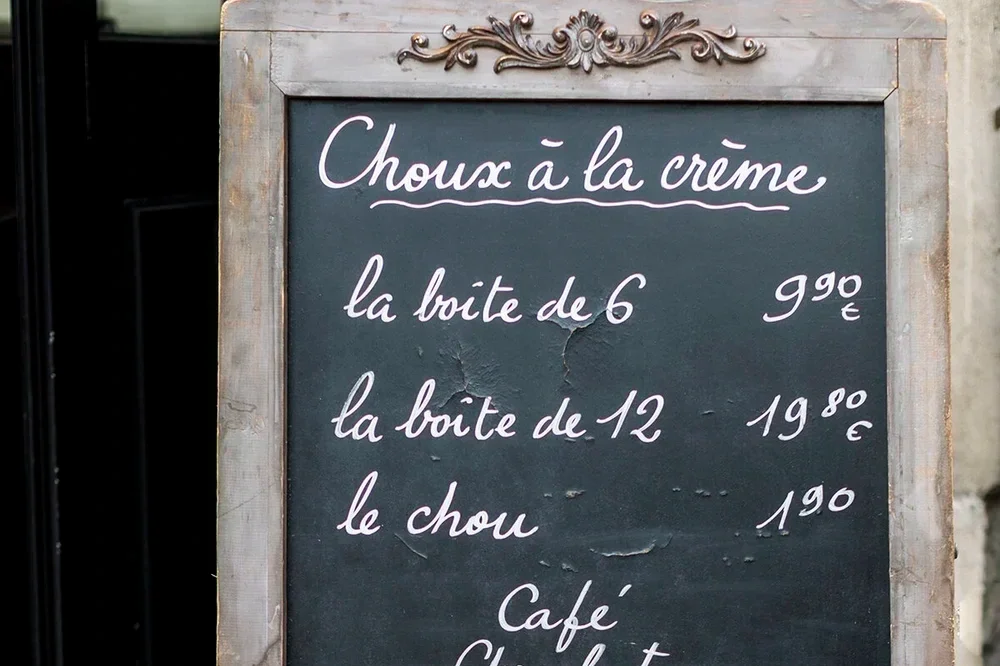
The 1 is the one that gets me, on signs and on handwritten menus. For about a second, a 14-euro plate on a restaurant chalkboard was a 74-euro plate, which is a very different lunch. I've since crossed over to the other side, and I write my numbers the French way now, upstroke and crossbar included, especially when I'm addressing an envelope.
The Comma and the Period Trade Jobs
In France the comma marks the decimal, and a space (sometimes a period) separates the thousands. What an American writes as 1,234.56 comes out here as 1 234,56, and a price on a menu reads 2,50 €, with the euro sign trailing the number instead of leading it. This one has never caused me a single problem, because context does all the work and nobody stares at a croissant wondering about its decimal point. It does still look, to an American eye, as though somebody hit the wrong key.
Day First, Then Month, Then Second Thoughts
French dates run day, then month, then year, so 03/04 is the third of April and not March fourth. Everything I use here is set to the French format, and day-first has long since stopped registering. The catch is that I still keep a foot in the US, with bank accounts, a storage unit, and the forms that come with them. When I recently had to sign and date my voter registration, my hand had to remember which country it was writing in.
The small mercy is that the confusion expires every month. Any date from the 13th onward can only be read one way, since no calendar has a 13th month. It's the first twelve days that deserve a second look.
Eighteen Thirty, With an h
France writes the time on the 24-hour clock, and it swaps the colon for a small h, so 18h30 is half past six in the evening. It turns up on train tickets, shop doors, and opening hours everywhere. I've never missed anything over it, but there have been moments when I looked at 18h30 and had to think twice about what it meant. The fix is to take twelve off anything after noon, which hands you back the clock you grew up with.
One Flight Short
French buildings start counting from zero. Street level is the rez-de-chaussée (ground floor), and the elevator button for it usually reads 0 or RDC. The premier étage (first floor) is one flight up, which an American would call the second, and everything above it follows suit. A French floor number is always one lower than the number you'd use at home.
I once took the stairs to a fourth-floor apartment, the fifth floor in American, counting like a Texan the whole way. Somewhere around what I'd have called the fourth floor, it dawned on me that I owed the building one more flight.
A 71 I Never Picked
Since 2009, a French license plate number has belonged to the car for life rather than to wherever its owner lives. The right-hand end of every plate still has to carry a department number and the matching regional logo, though, and the owner can choose any department in France. In other words, it's a declaration of loyalty, and you get to pick the team.
My 1992 Peugeot 205 carries 71, for Saône-et-Loire, which is where we live and which I would happily have chosen. I never got the chance. I took the car to my local garage, they handled the registration, and they picked it for me without asking. So my car pledges allegiance on my behalf, correctly, and without consulting me. Even reading it aloud takes effort, because 71 in French is soixante et onze: sixty and eleven.
Sixty-Ten, Four Twenties, and Other Arithmetic
French counts the way you'd expect up to sixty, and then it starts doing sums. Seventy is soixante-dix (sixty-ten), eighty is quatre-vingts (four twenties), and ninety is quatre-vingt-dix (four twenties and ten). At the top of the staircase sits ninety-nine, quatre-vingt-dix-neuf: four, twenty, ten, nine. French speakers in Belgium and Switzerland looked at all this and settled on septante and nonante for seventy and ninety, which I choose to take as a personal kindness.
Where it catches me is the register and the phone. A total ending in ninety-nine centimes arrives as four separate words that I have to assemble before I know what I owe. French phone numbers are read aloud in pairs, a perfectly sensible convention that guarantees a few of these compound numbers in every call.
The baguette took me two years to sort out. These days I could walk anyone through the floors, the commas, and the clock without breaking stride. Quatre-vingt-dix-neuf is another matter: it still costs me a beat, every single time, while four twenties, a ten, and a nine line up in my head and wait to be added together.
Want to see it in person?
We're planning My Life in Burgundy, a small-group journey for up to 14 guests through the churches, vineyards, and tables of southern Burgundy. Join the waitlist to hear first when details are ready. No payment, no commitment.
See My Life in Burgundy