
(5 minute read)
Every American family is convinced its Thanksgiving is the real one. Mine is in Texas, where the cranberry sauce slides out of the can in one piece with its ridges intact, the green beans go under condensed soup and fried onions, and my mom's corn casserole (canned corn, canned jalapeños, Philadelphia cream cheese) is the first dish to disappear. Your family's table probably looks nothing like that, and to you, yours is the real one. That's how this holiday works.
For the last few years, I've spent Thanksgiving at a different table, outside Paris, with a French family who keep the holiday because one of them spent half a century in the United States. It's an American Thanksgiving through and through. It just happens to be cooked in a French kitchen, poured with French wine, and talked over in French.
The Native Speakers
Paul's mother, Pierrette, lived in the United States for about fifty years. When she moved back to France in 2022, Thanksgiving came with her, and every year since, the family has gathered for it at the home of Paul's aunt and uncle. Pierrette and her sister, Marie-Cécile, take over the kitchen and cook the entire meal between them, from the turkey to the pies.
Around the table: Paul and me, Pierrette, Paul's niece, his aunt and uncle, their grown children, and the grandchildren. Four of us have lived in the States, and the rest know the holiday through us and through the meal itself. The first year I came, a couple of Paul's cousins turned to me over a dish and asked whether it was right, the way you'd check a tricky idiom with a native speaker. It's a fair question when you're keeping a holiday from someone else's country, and I took it seriously.
Every Square Inch of the Oven
It starts with the turkey, the same bird you'd buy in the States. French ovens tend to run small, and this one takes the bird with nothing to spare. It fits, technically, and that counts. Turkey is already the Christmas bird in France (the rest of that table is in Christmas in France, Like a Local), so the centerpiece is familiar to everyone. The sides are where the holiday gets its personality.
The cranberry sauce starts as whole berries, simmered until they pop, and it arrives at the table still looking like fruit. It's excellent, and it has never been anywhere near a can. The dressing gets its own dish instead of being stuffed into the turkey. The green beans show up as themselves, no soup and no fried onions, and the potatoes come out of the oven roasted rather than mashed. None of it would look out of place in plenty of American kitchens.
Marshmallows, on Purpose
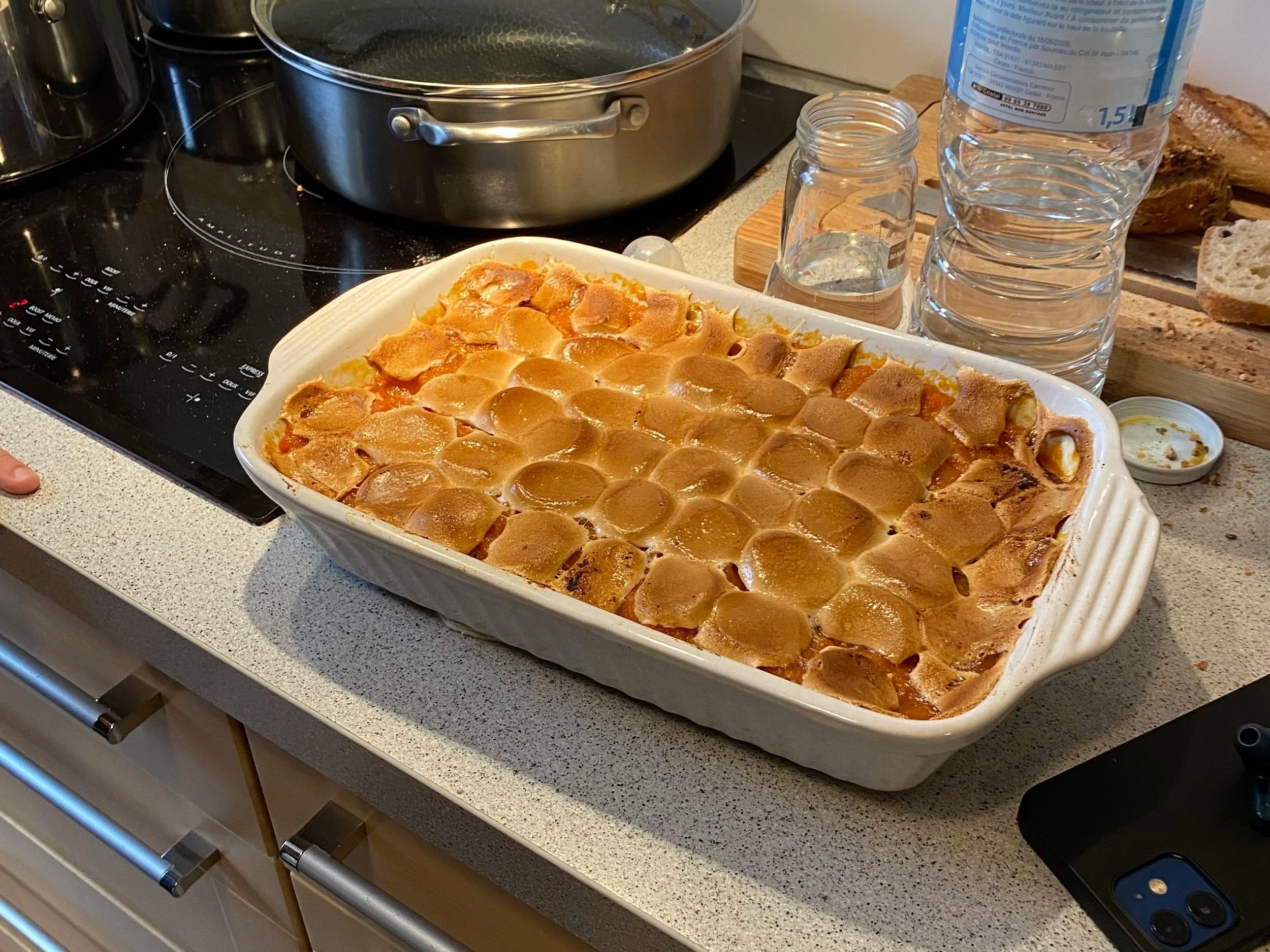
Then there's the sweet potato casserole, marshmallows and all, browned on top to the proper color. Pierrette doesn't make it because she considers it a culinary masterpiece. She makes it because it's one of the most gloriously strange things about an American Thanksgiving, and she wants her French family to see it. It's show-and-tell, and it works: nothing on the table says American holiday quite like a vegetable topped with candy.
Which gives me a theory. If canned cranberry sauce were easy to find around here, I suspect it might earn a spot on the table for the same reason, though I'm not certain she'd agree. For now, everything is made from scratch, which is how I assume Pierrette has always cooked it, even in the States.
Three Pies and a Bottle of Givry
Pierrette bakes all three pies: pecan, pumpkin, and apple. Last year, I helped with the pecan, in the sense that I pressed the crusts into the tins, poured in the filling, and got out of the way. The pecans came from Texas, brought over by a friend a few years ago, and Pierrette made them last until just recently. Her pie is built on classic French tart technique, and it came out firmer than the gooey pecan pie I grew up with, closer to a cookie. It was delicious, and so were the other two.
And there is wine with all of it. In our case it's a red Givry from the domaine in southern Burgundy where we buy most of our own, poured right alongside the marshmallows.
A Game From Another Century
Someone also decided, correctly, that Thanksgiving needs football. Not this year's game, though: someone pulled up a Dallas Cowboys game from the nineties on YouTube. Nobody in this family follows American football, so the score was never the point; the sound of it in the room was. We watched some of it, then let it run in the background while everyone talked over it, which in plenty of American homes is exactly right. The only thing missing was the one uncle or cousin who parks himself in front of the screen with a beer and yells at it.
Is It Like Home?
One of Paul's cousins once asked me whether it was authentic, whether it was like home. I told them it was better, and I meant it. Pierrette and Marie-Cécile are excellent cooks, and the meal they make is a better meal than the one I grew up with. It's also not quite home, and that isn't a knock on either table.
What makes a Thanksgiving feel right has little to do with how well it's cooked. It's the ridges on the cranberry sauce, the corn casserole with a kick, the particular dishes a family has decided can never be skipped. My family's version tastes like the holiday because it's ours. For the cousins and grandchildren growing up with this one in France, Pierrette and Marie-Cécile's Thanksgiving is becoming the real one, too.
So on a day at the end of November, which in France is just another day, with no parade, no long weekend, and nobody else in the country doing the same thing, the family gathers outside Paris, grandchildren, cousins, and all. There's a turkey filling the whole oven, a football game from another century, a red Givry, and a long table talking in French. I'm a long way from my mother's table this time of year, but I'm so thankful that a French family decided to keep this one.