
(6 minute read)
Travel writing has a house vocabulary: hidden gems, off the beaten path, authentic, unspoiled, like a local. There is nothing wrong with the words themselves. They have just been used so often, and so loosely, that a reader can no longer tell a true claim from a sales reflex. I've been trying to get them out of my own writing, and the honest place to start is what's already on this site.
Our very first blog post, "Becoming Tripologiste," went up in January 2025 and is still on this site. Paul wrote it, and somewhere in the middle of a good story he reaches into the travel industry's word drawer and comes out with both hands full. Europe, we learn, "is brimming with these hidden gems." The real beauty of travel lies in "uncovering the places off-the-beaten-path," which are "the places that only locals know." Corsica has "charming stone chapels nestled within unspoiled villages." And we are here to help you explore Europe's "undiscovered wonders" and its "lesser-known destinations" on "unique journeys that go far beyond the ordinary well-trodden paths," until you are "truly immersed."
Paul is delighted to be teased about this, which is the only reason I'm doing it in public. We stand behind every word of the story, if not the vocabulary, and we are leaving it up, because it is the best specimen we have.
Our Fingerprints Are Everywhere
It would be convenient to blame Paul. I can't. "Christmas in France, Like a Local" is a title I published, URL and all, less than a year ago. I don't love it, but I wrote it, and sometimes there is no clean way around a phrase like that.
The one that stings is "that's the thing nobody puts in the brochure." I can't stand platitudes like that, which made it a surprise to find versions of it in three of my own articles. Its job is to say we see what the others don't, which is the same flattery as the rest of the list, dressed up as straight talk.
None of this came from cynicism. When we started Tripologiste, this was the language on offer, and it arrives sounding like the way travel writing is supposed to sound. After nearly two years of writing this blog, my taste has gotten sharper, and some of what I was proud of has started to look a lot like what I was writing against.
I don't know what any other company intends when it writes "undiscovered," and I won't pretend to. Whatever the intent, the effect is flattery. This kind of language tells the reader they are not like the other travelers: they are the kind of person who finds things. It has also worked its way into how travelers describe what they want. "Off the beaten path" usually just means a trip that isn't wall-to-wall tourists. Fair enough. That's what we want when we travel, too. Though the moment you ask a travel company to take you off the beaten path, you've arguably lost the plot, and I'm aware that we are a travel company. I haven't worked out how to walk that line, and I'm not sure anyone has.
Spent Currency
Here is where it stops being a joke at my own expense. Southern Burgundy, where we live, is quiet. That is a plain, checkable fact about the place. Nobody is queueing for anything, and in nearly two years of driving out to the village churches I have never found a door locked, and most of the time I have the place to myself. The region is hardly unknown: its Chardonnay is on good tables, its Romanesque churches are in the art history books, and its culture runs deep. It just isn't where many tourists know to go.
So by any fair reading, it is off the beaten path, and we cannot write that, because the phrase has been spent. Use it, and we sound exactly like a company that has never set foot here. I once wrote that flânerie, the French word for aimless walking, had been used so often in travel writing that it had been sanded smooth. The same thing happened to this whole vocabulary. A word that gets used for everything stops telling you anything, including on the occasions when it happens to be true, and the people who were telling the truth lost the words along with everyone else.
The End of the Farm Track
That leaves one option, and it is a craft answer that took me nearly two years of writing this blog to work out. If you can describe a place faithfully, you don't need to announce that it is unspoiled, or undiscovered, or off the beaten path. The description does it for you.
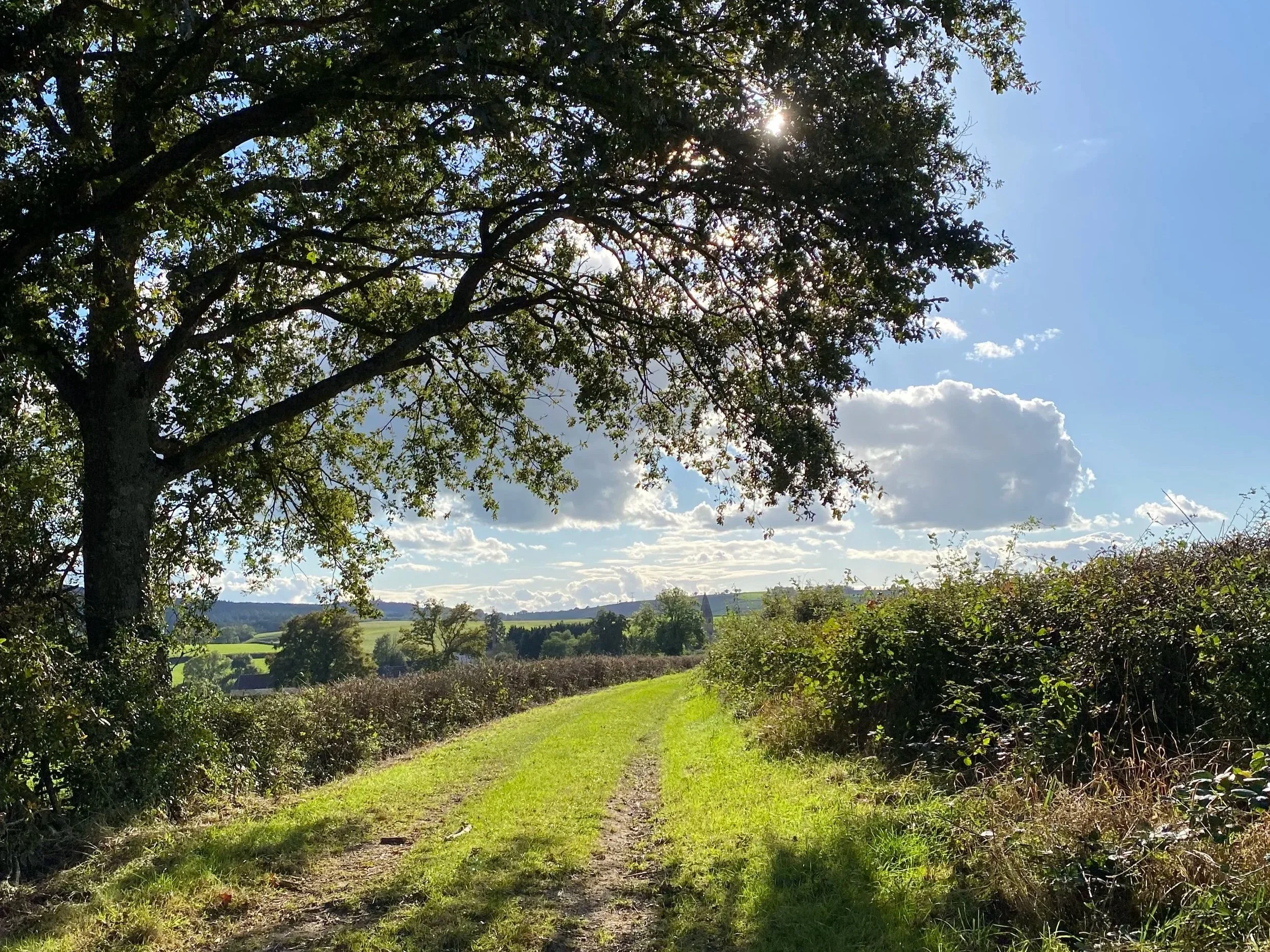
Here is the difference, using two sentences from this site. Our first post described ‘charming stone chapels nestled within unspoiled villages.’ A more recent one says that here ‘the eleventh century is ordinary building stock, sitting at the end of farm tracks and holding up the middle of small villages.’ Neither one is great literature, but the second never needs the word unspoiled. A reader can work out for themselves that a church at the end of a farm track won’t come with a tour group. The longer account of southern Burgundy is my attempt to do that at length.
If the quality can't be implied, say it plainly and skip the filler. Authentic is a perfectly good word with a dictionary definition, and I will use it when I mean exactly that and nothing grander. "Must-see" is hard to avoid, because some things are. And if something is once in a lifetime, I will say so, on the rare occasion that it is.
So no pledge, and no list of forbidden words taped above the desk. Just a working rule: describe the place well enough that it speaks for itself, and when it can't, say the thing plainly, once.
Glass Houses
I still need shorthand. People skim, attention is short, and even an article like this one has maybe two hundred words to land before a reader drifts off to check the weather. “Slow travel” is ours. There is no better way to describe how we think about travel, and we mean every syllable. It is also starting to irk me, mostly because I'm the one who keeps typing it, and repetition is how a phrase gets sanded smooth, even by people who mean it. I'm still not giving it up.
I will slip. I already have, in writing, on this site, with a URL. If one of those words turns up in a future post, assume it was the only one that fit, or that I was tired.