
(6 minute read)
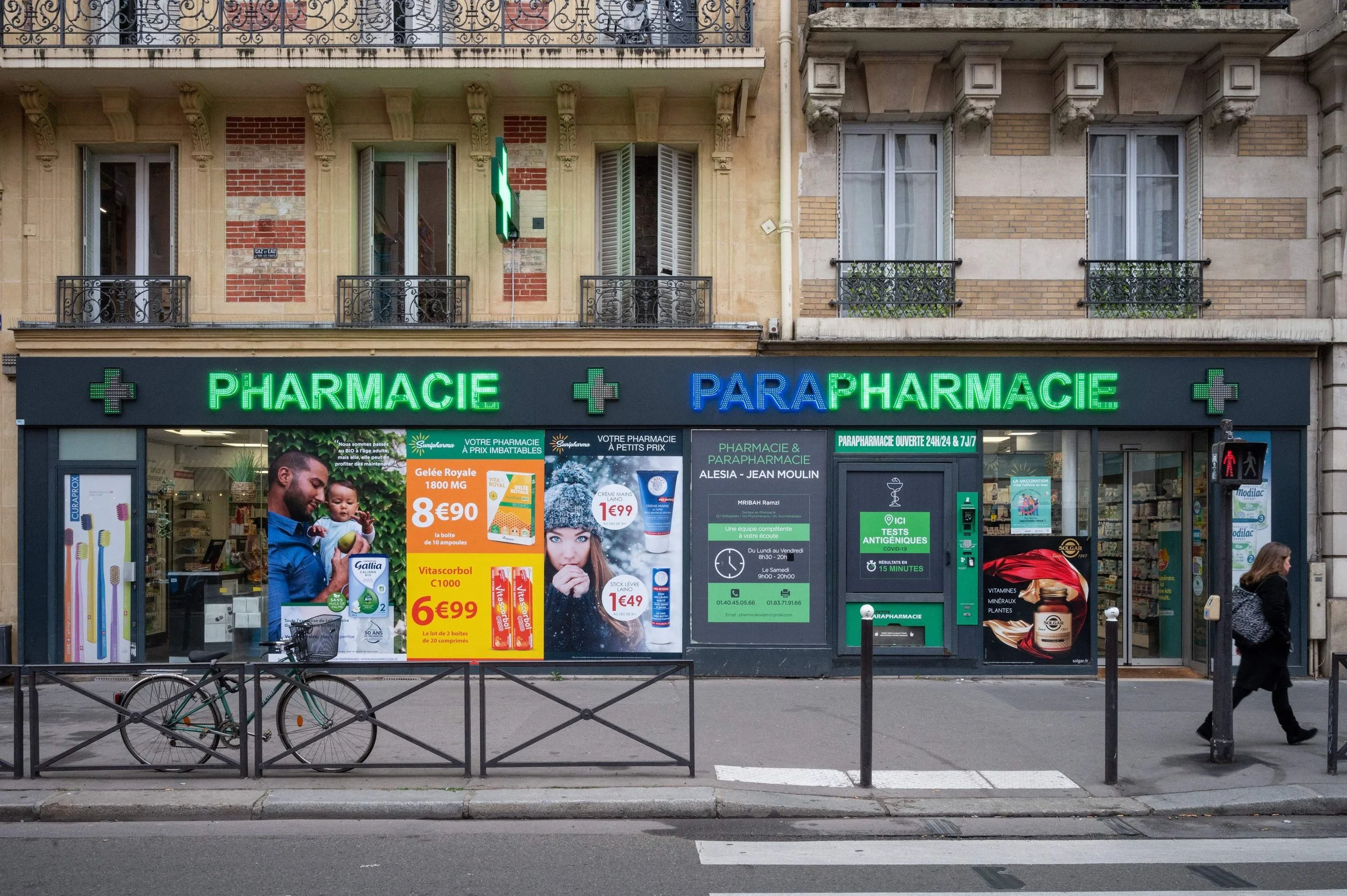
Every French town has one, and plenty have three. A green cross hangs over the door, lit up, flashing in patterns better suited to a nightclub, and in between the flashes it tells you the temperature. An American walks past and files it under "drugstore," somewhere between CVS and the place you buy a birthday card, but that’s the wrong drawer.
In France, the pharmacist is a health professional first. They dispense medicine rather than selling it, and nearly everything that seems odd about a French pharmacy follows from that one fact. It is why the painkillers live behind the counter, why the boxes are so small, why there is a second kind of shop for the face cream, and why the law insists that somebody nearby is reachable at three in the morning.
The Diploma on the Deed
The pharmacist's standing is written into the public health code. Only pharmacists may prepare and sell medicine in France, a monopoly the state grants in exchange for a diploma, a code of ethics, and personal responsibility for every box that crosses the counter. Only a pharmacist can own a pharmacy, too, so the one on your corner belongs to the person in the white coat rather than to a retail company. And advice is part of the job description. The pharmacists' code of ethics ties counseling to the act of dispensing, so the conversation belongs to the transaction itself.
That is the frame. The rest is what it looks like from the customer's side of the counter.
Nothing to Sell Me
A couple of weeks ago I had a stye. I was in the pharmacy in Genouilly, where I fill my prescriptions, and while I was there I asked the pharmacist whether there was anything I should buy for it. She looked at it closely and asked me a couple of questions before she gave her advice: warm compresses, and come back if it gets worse.
That was the whole consultation. No appointment, no fee, and no attempt to find me something to take home. She knows me as a regular from my monthly prescriptions, she works in front of shelves full of things she could have sold me, and she still did not try.
At home, the same eyelid would have gone one of two ways. Either I would have stood alone in the eye-care aisle reading the backs of boxes and paid for drops that might not have been the right thing, or I would have booked an appointment and spent a copay and an afternoon being told about warm compresses. Here the same advice came from someone with a doctorate in pharmacy, at least six years of university study, and it took one question asked while I was already at the counter. I walked out with exactly what I needed, which was nothing.
Ask, Don't Browse
The medicine I would have grabbed off a shelf in Dallas, I ask for here. Since January 15, 2020, paracetamol (acetaminophen, sold in the US as Tylenol), ibuprofen and aspirin have had to sit behind the counter by order of the national drug agency, the ANSM, which said in plain terms that it wanted a pharmacist's advice between the customer and the box. A few other over-the-counter medicines can still be set out on open shelves inside a pharmacy, but the everyday painkillers cannot. My allergy pills, cetirizine (the active ingredient in Zyrtec), sit behind the counter at both of the pharmacies I use, too.
Asking is not an interrogation. With the cetirizine, they usually confirm that it is for allergies, sometimes remind me how to take it, and that is that.
What tends to catch Americans out is the size of the boxes. Most of what I buy comes in roughly a week's worth, where at home I would have bought a bottle of a hundred and forgotten about it until 2029. For paracetamol this is a rule rather than a habit: since the early 1980s, a single box sold in France can hold no more than eight grams, which is eight tablets at 1,000 milligrams each. Without a prescription, the label tells you to stop after three days for a fever or five for pain.
The one time I asked for a second box, I was in the middle of the vendange (the grape harvest), picking on a hillside above Givry with a back that had filed a formal complaint. I explained, and the pharmacist said she understood, and that was the end of it. Whether she would have been as easygoing without the reason, I cannot tell you.
Melatonin is the other place I run into the line, and there the line is really two rulebooks meeting. Under two milligrams a dose, an administrative ruling lets it be sold as a food supplement, which is why 1.9 is the strongest you will find on the shelf. The two-milligram version is an authorized medicine, and it needs a prescription. My own doctor looked at that ceiling and told me to bring stronger pills back from my next trip to the US.
A Basket of Mushrooms
Many travelers have heard that a French pharmacist will look into a forager's basket and say which mushrooms are safe to eat, and in autumn some of them do. It is a real tradition, but it is not a legal duty, and I have not seen it happen myself. Training varies, and a 2025 university study of pharmacists in the Pays de la Loire found many felt underprepared for it and wanted more. A good pharmacist will tell you plainly when they do not know, which is the most professional answer there is when the alternative is a guess about a mushroom.
The Shop Next Door
All the things that do not need a pharmacist's judgment have their own home: the parapharmacie. Face wash, moisturizer, vitamins, soap, sun cream. Most pharmacies carry a shelf or two of these, and both of mine are really a pharmacy and a parapharmacie under one roof. But there are stand-alone parapharmacies that sell no medicine at all and carry a far wider range of the extras. When all I need is moisturizer, a parapharmacie also spares me the pharmacy line, which moves slowly because the people in it are picking up prescriptions or asking the pharmacist for advice.
The existence of a separate shop for the soap is the clearest sign of where France draws its line. Everything on one side of it needs a professional. Everything on the other side can be browsed.
After Hours
Then there is the night. Every pharmacy in a given area is legally required to take its turn in a rotating on-call service, organized department by department, so that someone can always dispense medicine after hours. At night, the pharmacy on duty may be working behind a lowered shutter and is best reached by phone first. Pharmacies post the name of whoever is on call, and there is a national line, 3237, though the call is billed by the minute (between 15 and 35 euro cents depending on the department) while the website, 3237.fr, is free. I have never needed it, which is how I like it.
Nobody passes a law requiring the corner store to be reachable at three in the morning. France passed one for the pharmacist.