
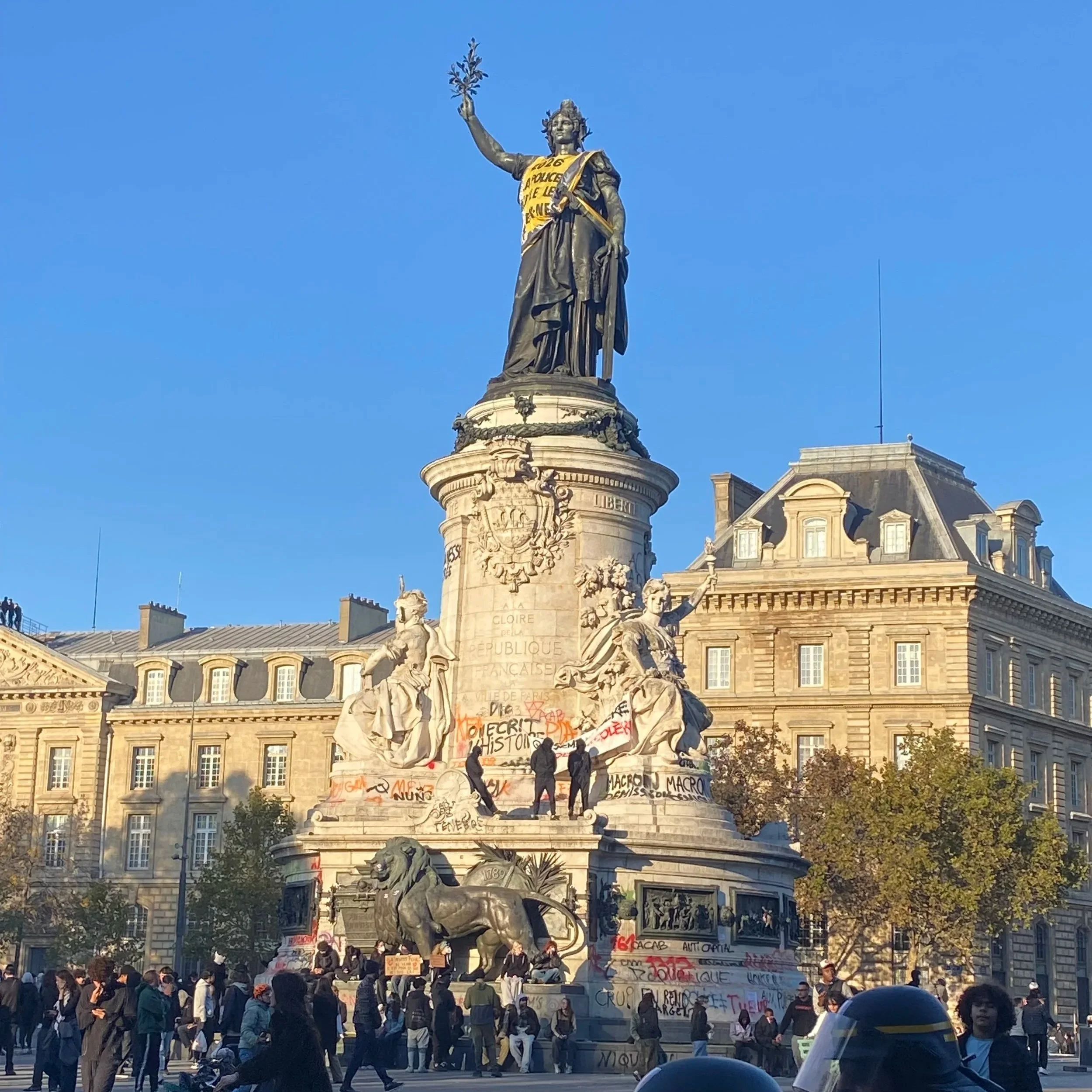
Place de la République, Paris, October 18, 2026
(9 minute)
Written in Paris and current as of October 27, 2026. The examples come from this fall's protests, but the advice holds for the next round, too.
You booked the hotel months ago. Maybe there's a table waiting at a bistro you've been reading about since spring, or a rental car in Lyon for a slow drive up through Burgundy. Then the news fills with burning cars, riot police and tear gas, and every headline seems to have the word France in it. It's a fair moment to wonder what you've gotten yourself into.
We live in France, and we've been in Paris through the largest protests the country has seen in years. The honest answer to that worry has two halves. Most of the country, most of the time, looked the way it always does. Business as usual. And some of what you've seen on the news is real, serious and worth understanding before you go. A traveler who keeps both in mind will make better decisions than one who only hears one of them.
A Country That Takes to the Street
To many Americans, hundreds of thousands of people in the streets reads like a national emergency. In France, it's closer to a civic habit. The right to demonstrate is protected by the constitution, and people use it constantly: unions march over pay, farmers drive tractors into town centers, and students blockade their own high schools. Most of these protests are so routine that they barely make the evening news.
This fall, several of those grievances arrived at once. High school students began protesting in mid-September against overcrowded, crumbling schools and staff shortages. Anger over fuel prices and the cost of living followed, sharpened by a proposed 2027 budget that seeks 54 billion euros in savings and keeps civil servants' pay frozen. Students, firefighters, farmers, nurses and a revived gilets jaunes (yellow vests) movement, which first appeared in 2018, all took to the streets, sometimes together and sometimes on their own schedules.
On Saturday, October 17, the Interior Ministry counted about 550,000 marchers nationwide, while organizers claimed 800,000. The great majority marched peacefully. That day also brought the worst destruction France has seen in years. The historic town hall in Limoges, inaugurated in 1883, was in large part destroyed by fire, shops were looted in Paris, Lyon, Marseille and other cities, and the Interior Ministry reported 2,628 arrests and more than 1,100 injured officers.
The force has not run in one direction only. Human Rights Watch has documented riot police using tear gas, stun grenades, batons and rubber bullets on children during the student protests, and several teenagers have been badly hurt, two of them losing a hand to police grenades. Several of these cases are under investigation.
The following Saturday, October 24, was calmer. The Interior Ministry counted about 410,000 marchers nationwide, with half as many arrests as the week before and 53 injured officers, down from more than 1,100.
How a Protest Finds a Visitor
For most travelers, a protest never becomes more than a crowd seen from a distance and a few alarming headlines. When one does reach you, it tends to arrive in a handful of predictable ways, and almost all of them are inconveniences rather than dangers.
The first is closures. On Monday, October 19, about 50 students from the École du Louvre (the art history school next door) blocked the entrances to the Louvre, and the museum could not open that morning. Staff told visitors their tickets would be refunded, which was cold comfort for anyone who had planned the visit for months. On a protest day, a handful of metro stations near the march route may close while the rest of the network runs as usual. On October 17, that meant three stations on our line. Shops along the way board up their windows the day before. It looks alarming, and mostly it means the owners have been through this before.
The second is curfews and gathering bans. After October 17, Paris police set an overnight curfew for a week, from 11 p.m. to 6 a.m., on the central island of Place de la République and around the Les Halles shopping district, and banned demonstrations near Bastille, Place d'Italie and the major train stations. Lyon set a 9 p.m. curfew in its city center, and Lille and several towns in the north imposed curfews on minors. These measures are narrow, local and announced in advance, and a visitor having dinner in another neighborhood would never notice them.
The third is strikes, which in France are announced ahead of time, almost to a fault. Transport workers must declare their intention to strike at least 48 hours in advance, and the SNCF (the national rail company) publishes the next day's schedule the evening before. As of this writing, all four major rail unions have called a strike for Thursday, November 5, the same day the main labor unions have called a national day of action. If you have a train that day, the schedule you need will be on the SNCF Connect app the night before. We wrote more about how French strikes work in Sundays, Siestas, and Strikes.
The fourth matters most in the countryside, and it's the one someone driving through Burgundy is most likely to meet. On protest days, groups sometimes occupy a roundabout or set up a barrage filtrant (filtering roadblock), letting cars through slowly, a few at a time. On October 17, gilets jaunes returned to roundabouts across the country, including in our own corner of Saône-et-Loire. These are usually more tedious than tense. Expect a delay, maybe a leaflet through the window, and a good deal of patience from the drivers around you.
Two Saturdays in Paris
Most days this month looked like any other in Paris. The metro ran, the restaurants were full, the shops and museums were open, and on Wednesday, October 21, we went to Notre-Dame (we hadn’t been inside since the renovation). In our part of the 19th arrondissement, you would not have known anything had happened.
On October 17 itself, we spent the day across the center of the city. In the Marais, we watched a protest march pass on its way toward Notre-Dame, and it was exactly what you picture when someone says peaceful protest: people with handmade signs, songs and chants, drivers honking in support, and not a police officer in sight. Anyone who lives here has seen marches like it many times. Then we walked north toward Place de la République, past shops boarded up in advance, something you never see on an ordinary Saturday, and got close enough to the tear gas to smell it and feel a little of its sting. Nobody aimed anything at us and we never got the full effect, but it was enough. With the police clearing the area, we turned around.
It should be said that we walked toward République knowing what we might run into, and we did it because we live here and wanted to see for ourselves what was happening. A visitor has no reason to make that walk.
The next day, République looked like a square recovering from a hard night, with broken shop windows, a burned-out car, a heavy police presence and onlookers waiting to see what would happen. Around the edges, kids were skateboarding and people were having coffee at the cafés. That evening, leaving dinner in the Marais, we watched a handful of teenagers break into a Coach store. They were skinny, opportunistic kids taking their chance while the police were busy elsewhere, far more interested in handbags than in the people watching from across the street, and they scattered at the first sound of police. It was unsettling to see, and it was over in a couple of minutes.
On October 24, the Paris march was supposed to leave Bastille for Nation at 2 p.m. The evening before, police moved it out of the center to the boulevards at the city's edge, from Porte d'Italie to Porte de Vincennes, and a court rejected the unions' challenge. We were near Bastille at 2 o'clock and walked over to see what was left. Police checked our bags as we approached, a few journalists waited for something to happen, and nothing did. Across town on the outer boulevards, about 110,000 people were marching, as many as the Saturday before by the authorities' count. Sunday was quiet, and on Monday we went shopping among crowds of tourists having a perfectly lovely time.
Two people can only be in a few neighborhoods at once, so take this for what it is: a picture of what these weeks looked like from where we stood. It isn't proof that every street in every city was calm, and we won’t pretend that they were.
Where Not to Be
The single best thing a visitor can do is stay away from the places where crowds and police meet. In Paris, marches traditionally gather and end at Place de la République, Bastille and Nation, and on a protest day those are the squares to skip. In other cities, it's usually the main square or the old town center, such as Place Bellecour in Lyon. The march itself is rarely the problem, as those students in the Marais showed us. Trouble, when it comes, tends to come where the crowd stops moving.
Protest days are announced well ahead, and most fall on Saturdays or on weekdays called by the unions. A look at the news for the dates you'll be traveling tells you most of what you need to know. If you have timed tickets for a major museum, check its website the morning you go, and if you're taking a train on a strike day, check the schedule the night before.
As for the official word, the US State Department kept France at Level 2, "exercise increased caution," through October, the same level it held before the protests began. Its own advisory notes that demonstrations in France are frequent and usually peaceful. Readers traveling from elsewhere will find their own government's travel page the place to look.
What's at Stake
The people marching this fall include students who want classrooms that aren't falling apart, firefighters coming off a summer of the worst wildfires France has seen in decades, and families watching the price of everything climb. Whatever a visitor makes of the budget debate, a closed metro station or a rerouted afternoon is a small inconvenience next to what's at stake for the people living it. A traveler who understands that will have a better trip.