The Corsica Trip We'd Never Plan for You
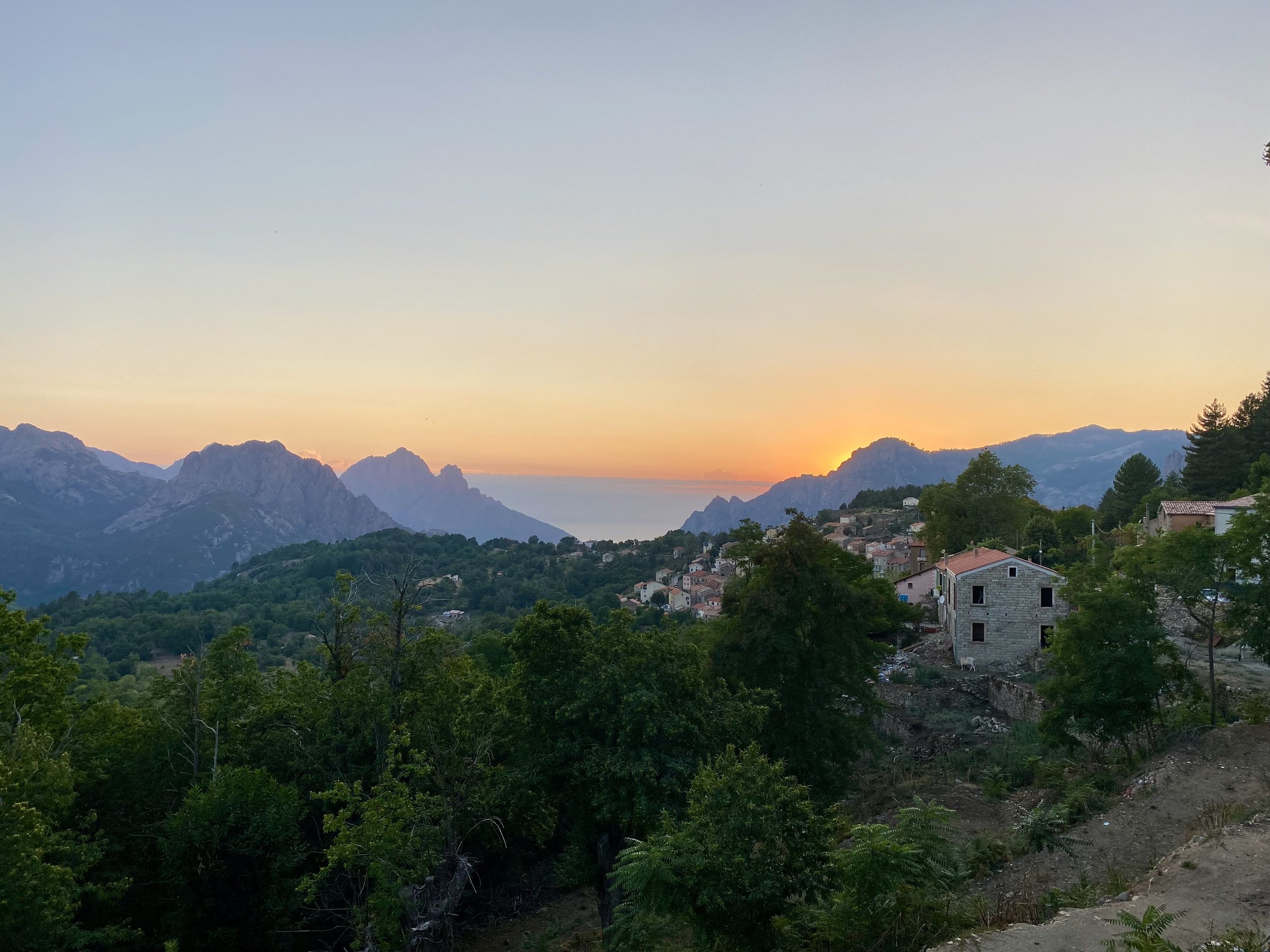
Our view from Cristinacce.
(17 minute read)
Traveling with a good friend for the first time is an experiment with a real failure rate. You don't find out how compatible you are until you're in a small car together, sunburned, underslept, and lost in the second-worst way, which is the way where one of you is confident.
In August 2022, Paul and I found out. We were at his mother's house in southern Burgundy for a large family reunion, and it was wonderful: long tables, too much food, pétanque in the late light, cousins arriving with more wine. After several days of this we looked at each other with the specific restlessness of two people who are having a lovely time and would like something to happen. So we booked a room in the Corsican mountains, an overnight ferry out of Nice, and a rental car, and we left.
We've called that week the founding trip of Tripologiste ever since, and we mean it. It is also, almost line for line, a trip we would never sell to a client.
Both of those things are true. The distance between them is the whole job.
The Cheapest Bed in the Mediterranean Is a Chair
Corsica Ferries runs an overnight from Nice to L'Île-Rousse. It sails at eleven at night, lands at seven in the morning, and will cheerfully sell you a cabin with bunks in it.
We did not buy the cabin. We were young and thrifty and rather pleased with ourselves about it, so instead we bought Pullman seats, which are airline seats that recline the way a dentist's chair reclines, arranged in long rows in a dim room full of strangers who have also made a mistake.
We got to our row and found a biker asleep on the floor of it. He hadn't booked a seat. He had simply lain down in the aisle between ours like a man who had decided the boat owed him something, and we had to wake him and ask him, in French, to move. He didn't protest, because he knew perfectly well it wasn't his spot. He just gathered his things and shuffled off looking tired and slightly wounded, and for a moment we were unmistakably the villains of the story, two Americans in a Mediterranean ferry lounge evicting a sleeping man from the floor on a technicality.
What followed was not sleep. It was a long horizontal argument with consciousness, conducted under fluorescent half-light while people shifted and children cried, and at one point a woman near enough for us to see was very loudly and comprehensively sick, which nearly took me with her in a spirit of solidarity.
We landed at seven anyway, because the boat does not care. And L'Île-Rousse in the early morning was so absurdly beautiful that we walked straight down to the water with our shoes in our hands and stood in it, blinking, letting the light do what it could for us. The Mediterranean is a shameless flatterer. It will forgive you a night like that in about ninety seconds.
The cabin costs money. The night cost us a day. That's the trade, and it's a bad one, and I remember it fondly, and I would never do it to you.
A Dozen Houses, a Fountain, and Aurélien
We had decided, sight unseen, to stay up in the mountains rather than in one of the coastal towns. Partly this was money. Mostly it was a hunch that whatever was true about Corsica was true up there rather than down at the marina.
Cristinacce is a dozen houses, a church, and a fountain, hung high on a slope. We stayed at the Gîte d'Étape ACALATA, which is a walkers' lodge in the plainest sense of the word: one room, two bunk beds, a bathroom, and a nightly rate so low that I have genuinely forgotten it, the way you forget the price of a coffee. Let me be clear that this was our budget talking and not our taste. Corsica has beautiful places to stay. We simply were not in one, and we didn't care, because we were twenty feet from the only bar in the village and it was run by our host.
Aurélien greeted us like a man who had been expecting us for years. He was somewhere in his forties, wide and warm and entirely of that place, and he ran the gîte and the bar underneath it with the easy authority of the only person in the village who has both keys.
We slept a hard, drooling, restorative nap, and then we went looking for pizza.
Every morning after that, the bar downstairs filled with the village: coffee, the newspaper, gossip conducted at a volume that suggested nobody had anything to hide and everybody had something to say. Aurélien would see us on the stairs and start making espressos without asking, and he never once charged us for them. There was a basket (un panier) of croissants and pains au chocolat on the counter for one euro, which I assume came up from a bakery somewhere below us, and they were superb. My French in 2022 was decorative at best, so he talked to Paul and I nodded a great deal and grinned like a dog in a car window. It works. You can get to know somebody perfectly well from two feet to the left of the conversation.
The Poster on the Wall
Ten minutes down the road is Évisa, and on our first afternoon we drove there for no reason at all, which turned out to be the most important decision of the trip.
We had nothing planned. We wanted pizza and a coffee and a look at where we'd landed. And while we were sitting there, people began carrying tables into the street, and on a wall there was a flyer, in French, announcing a village fête that night.
We spent the rest of the day wandering, eating chestnut omelets and drinking myrtle berry wine, which are the sorts of Corsican specialties you order because they sound like something a witch would give you. And at a quarter to ten we drove back down to Évisa and found the whole village outside in the dark.
It began with a single acoustic guitar and escalated, as these things do, into something like a rock band, and everybody danced. We danced with people. We talked with people. Teenagers were running the bar with the sublime confidence of teenagers who have been running the bar for several years. I ordered a rosé, and the girl behind the counter asked me "glaçons?", meaning ice, and I stood there with my mouth slightly open, and she turned her head and shouted down the length of the bar, "ee iz eenglish," and then walked away without ever looking at me again. She was about sixteen. Another girl came over and asked, in English, whether I wanted ice.
I have been insulted more elaborately. I have never been diagnosed so fast.
We were almost certainly the only tourists there, and nobody minded, and nobody made anything of us. We drove home at midnight full of rosé and other people's music, and on the walk back to the car, on a village road lit by a single streetlight, an enormous pig came out of the dark at speed. I mean the size of a small horse. It crossed within ten meters of us at a determined trot, on business of its own, and vanished.
Welcome to Corsica.
Roads Where the Livestock Has Right of Way
The mountain roads of Corsica are gorgeous and completely deranged.
Pigs, goats, cows, and dogs use them as they please, standing in the middle of a blind curve with the serenity of creatures who have never once been asked to move. More than once we came to a full stop while a family of goats crossed at a pace that can only be described as editorial. They were not frightened of the car. They gave the distinct impression that they had seen cars before, and had not been impressed.
The road itself does nothing to help. It hairpins along cliff edges with no guardrail, no shoulder, and no evident interest in your survival, and at night your headlights are the only thing announcing you to whoever is coming the other way. The locals, meanwhile, drive it like a rally stage, treating the center line as a rough philosophical proposition. We spent a lot of that week gripping the wheel and laughing the high, unconvincing laugh of men who have just been very nearly killed by a cow.
This, incidentally, is the part we'd tell you about before you booked anything. Not to talk you out of it. Just so that the goats are a story and not a surprise.
The Hike That Almost Killed Us
The next morning we set out for Capu Rossu, a headland on the west coast with an old watchtower standing on top of it.
I want to lay the sequence out honestly, because for years I've told this as a story about heat, and it isn't. It's a story about four decisions.
The reviews online said the hike was easy. We believed the reviews online. A local in Aurélien's bar, hearing our plans, raised an eyebrow and told us in French that it was too hot, and everyone else in the bar agreed with him, and the two of us thought: we're from Texas. We took one Nalgene of water each. And we parked at the trailhead and started walking at eleven thirty in the morning, in August, in Corsica, downhill first, which is the cruelest possible architecture for a trail, because the whole bill arrives at the end.
For the first two or three miles it was a lie of a hike, gentle and downward and staggeringly beautiful. The Mediterranean lay below us going through every blue that has ever been named, the cliffs fell away in great rusted slabs, and the pines held the light like they were being paid for it. It did not look real. We stopped in some stone ruins near the bottom and took Polaroids, feeling like men who had cracked something.
Then we turned uphill, and Corsica presented the invoice.
Partway up the ascent, Paul stopped in the shade and sat down and said he'd wait there and cool off. That was the correct call and he made it clearly and early, which is more than can be said for me, because I kept going. I was fitter and more stubborn, and only one of those was doing me any good. I made the top. The view from the tower was enormous and silent and worth, I would estimate, one tenth of what came next.
By the time I got back down to Paul, forty minutes later, the heat had found me too. And we still had to climb the "gentle" descent.
What followed stopped being a hike and became a pilgrimage of the least holy kind. No shade. No breeze. No end. The sun sat overhead with the smug flatness of a thing that has never had to walk anywhere. Our shirts were soaked through, our legs had begun to file complaints, and we had stopped talking entirely, because talking costs water and we had run out of water.
Salvation came in the form of an Italian family walking the other way, who took one look at our faces and poured some of theirs into our bottles. Paul thanked them in the Italian he has. I have thought about those people many times since, and I hope their lives have been long and shaded. We reached the car around three, climbed into it like men being extracted from a mine, and drove directly at the sea.
And here is the part I can't reason my way out of. Every element of that hike was avoidable, and it remains one of the best days of my life. The suffering isn't incidental to the memory. It is the memory. If a client of ours started that climb at eleven thirty in August on two bottles of water, we would consider it a serious failure on our part, and we would be right.
I still wouldn't trade the afternoon. That contradiction isn't a flaw in the story. It's the story.
The Girl Scouts Saw Everything
Plage de Ficajola is a pebble cove at the bottom of the cliffs below Piana, and it was precisely what our bodies were screaming for.
The road down to it is narrow, steep, and lined with parked cars on one side, with traffic coming up the other and a serious drop beyond that. Squeezing right to let a car by, we scraped the side of one of the parked ones. And standing on the road, watching, was a group of uniformed Catholic girl scouts, who stared, and pointed, and conferred among themselves, and looked at us the way saints look at sinners in the lower third of a fresco.
Paul left a note under the wiper. In English. It said, roughly, sorry, I scraped your car, here's my number, and it was signed Paul Browning, who is fluent in French and made a tactical decision that afternoon to be a confused American. I am not going to dress that up for you.
Then we went down to the water and had several hours of undiluted bliss: floating in the cold, drying salt-stiff on the hot stones, watching people hurl themselves off the cliffs into the sea with a whoop and a slap. We lay there like lizards, ruined and happy, and let the day be forgiven.
Then Paul's phone rang.
The voicemail was from a German woman. She was sharp, she was magnificently furious, and she informed us that she had spoken to the police, and that the police required us to present ourselves at the station. Ten minutes later we were driving to Piana in a state of quiet dread, imagining the gendarmerie, running through our French, considering our sins.
She was bluffing. She was completely bluffing. We found her and her husband in the village square, and the husband turned out to be from Garland, Texas, which is about twenty minutes from where Paul and I grew up. The whole thing collapsed into laughter almost instantly. We swapped insurance details, shook hands, and no claim was ever filed. It remains the only automotive incident of my life that ended in a warm conversation about the suburbs of Dallas, and I suspect she made the call rather than her husband precisely because she knew he'd be no good at it.
Napoleon Left From Here, and So Did We
The next day we drove to Ajaccio and went to Maison Bonaparte, the house Napoleon grew up in, which is handsome and stern and full of period furniture. What I actually remember, out of the whole collection, is a crown in a case that looked like a laurel wreath, and the odd sensation of standing in the childhood home of a man who could not wait to leave.
Then we found a beach with a sign on it explaining that this was where he left from. We stayed until the sun went down, and ended up standing at the bar of a beachside restaurant because every single table was reserved for a private event, eating tapas and watching a French singer perform Rihanna and Whitney Houston to a room of wealthy diners while getting a genuinely remarkable percentage of the lyrics wrong.
We had planned to drive to Porto-Vecchio the following day. Instead we went back to the same beach, because it had been perfect and we couldn't think of a good reason to improve on it. We packed sandwiches and beer and did nothing whatsoever for an entire afternoon, among Corsicans who were doing nothing with far more style than we were. The great event of the day was a jellyfish that drifted into the cove, prompting a standoff at the water's edge and a lengthy public debate about what, if anything, ought to be done.
We saw one town fewer than we intended. It was one of the best days of the trip. You don't get the second without agreeing to the first, and most itineraries are built by people who cannot agree to the first.
That evening we climbed back into the mountains for our last dinner in Cristinacce, and as we came over the top the island decided to show off. The sun broke apart in the valley below us and threw fire across the whole thing, oranges and dusky purples and a pink that I have not seen since. We pulled over and got out and stood on the road and didn't say anything for a while. That photograph at the top of this piece is that evening, though it hardly does it justice.
The Pétanque Tournament
On our final morning, Aurélien came out to say goodbye, and mentioned that there was a pétanque tournament in the village that day, and asked whether we'd like to stay for it.
We said no. We had a midnight ferry out of Bastia and a whole day to fill, and we had decided, in advance, that the day belonged to Bastia.
So we drove the length of the island instead, through the Forêt de Vizzavona, where ancient pines stand in mist over moss-covered rock and the world briefly stops existing, and down through the hills into the heat, past Genoese towers keeping their long watch over the coast. Bastia was lovely. We drank pastis on a sunny terrasse, wandered into yet another festival, and Paul caught sight of a tap dance troupe, said "I can't," and turned on his heel without a further word. I bought a souvenir of Corsica in the form of a glass sculpture, which I later discovered had been made in Sweden, and which Paul has never once allowed me to forget.
So: we turned down a pétanque tournament in a mountain village where we knew the bartender, in order to keep an appointment with our own itinerary, and I came home with Swedish glass.
Of everything we got wrong that week, that's the one I'd take back.
What Travels, and What Doesn't
We used to tell this story as proof that you shouldn't plan. It isn't. Look at what the good parts were actually made of.
The festival happened because we had an empty afternoon and drove somewhere with no agenda. Aurélien happened because we never rushed out in the morning. The second beach day happened because we were willing to lose Porto-Vecchio, and the pétanque tournament didn't happen because, for one day, we weren't. None of that is spontaneity as a personality trait. It's slack, deliberately left, and slack is a thing that can be built into a trip on purpose, which is precisely what we do now. One real thing a day, a museum or a producer or a walk or a long lunch, and then the rest of the day left open with our blessing. Book the meals you truly care about. Leave the others to the evening and the weather and your mood. And on your first day, settle in, eat somewhere close, and go look at what's around you, because that is the afternoon that finds you the poster on the wall.
And then there's everything else. The Pullman seats. The single Nalgene. The mountain at midday, after a man who lives there told us not to. The scraped car and the girl scouts and the whole glorious catastrophe of it.
We'd take the cabin now. We'd do that hike at six in the morning, or not in August at all. We'd believe the man in the bar the first time he said it. Not because those days were failures, because they were nothing of the kind, but because they were ours. We got to be young and stupid on an island in August, and we're not sorry, and we came home with a story we've been telling ever since.
That's the difference between the trip you take and the trip you make for somebody else. We know exactly how bad those seats are, because we sat in them. And we know where the poster on the wall is, because we were standing in front of it with nowhere to be.
We turned down that pétanque tournament and I still think about it. What's the invitation you said no to because you had somewhere else to be, and do you regret it? Or tell us we're wrong, and that the plan was worth keeping.