
The Best Thing We Ever Did in Paris Was Have No Plan
(7 minute read)
Paris is the most over-itineraried city on earth, and you already know this, because you have been. Possibly several times. You have done the Louvre and the Tower and the boat, and you have stood in the queue outside Sainte-Chapelle watching it move like a glacier. Somewhere in a drawer there is a laminated card from a tour company with eleven things on it and a meeting point.
So here is our advice for the next trip, and it is going to sound like we are trying to get out of doing our jobs: don't plan the middle of the day.
Not the whole trip. Book the table you care about, get the tickets for the exhibition that closes in March, sort the train. But leave a hole in the afternoon, and leave one in the evening, and then have the nerve not to fill it. We know how that sounds coming from people who plan trips for a living. Stay with us.
Walking with nowhere to be
The French have a word for aimless walking, and it has been used so often in travel writing that it has been sanded smooth. Flânerie. You have seen it in a hundred blog posts, always followed by a line about how Parisians are experts at it, as though it were a national qualification you sit an exam for.
Here is the useful version. Flânerie is not strolling, because strolling is what you do between two places you already meant to go. Flânerie is walking with no destination at all, which is much harder than it sounds. Your feet keep asking where they are going, and you have to keep declining to answer. It takes roughly twenty minutes to stop feeling like you are wasting the day, and that twenty minutes is the entire barrier. Push through it and the city starts handing you things: a courtyard someone left open, a shop that sells exactly one product, a street that is inexplicably full of pianos.
None of it is on anyone's list, because none of it is worth a list. It is worth an afternoon, which is a different unit of measurement and a better one.
The café is not the point. The café is the pause.
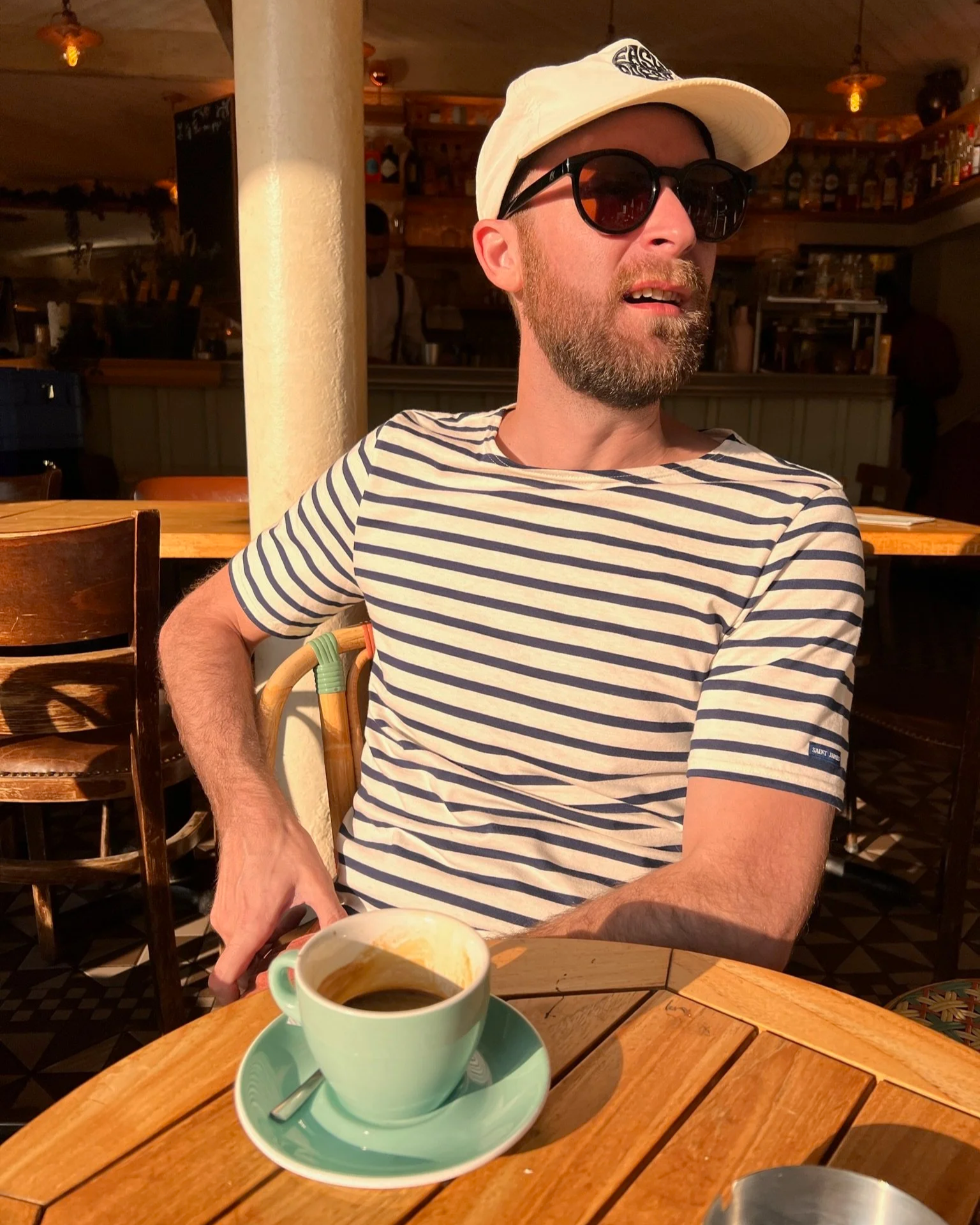
Every guide will tell you to sit in a Parisian café and linger, as though lingering were an activity you could book. We use them completely differently. When we don't know what to do next, we stop at a café, and that is the entire system: we pick whichever one is in front of us and looks decent, we sit down, and we work out what we want.
The part people find hard to accept is that most of them are decent. You do not need to research the café. Researching the café is how you end up walking nineteen minutes past four perfectly good cafés in order to reach a mediocre one with a strong rating. So we sit, and we order (a noisette, an espresso with a drop of milk, in the morning; a beer in the afternoon; a negroni once the light starts going), and then we look up and consider the afternoon. Quite often the answer turns out to be nothing yet, and we stay another twenty minutes.
That is not killing time. It is the mechanism. An unplanned day gets its next instruction at a café table, and it will not give you one unless you sit still long enough to hear it.
Once in a while we break our own rule and go somewhere specific for exactly this purpose. Rosa Bonheur, up in the Parc des Buttes-Chaumont, is not a classic Paris café at all. It is closer to a beer garden: picnic tables, a rough sort of terrace, and the whole park laid out below you. You do not duck in there for ten minutes. You sit down and lose an afternoon watching Parisians be Parisian, which is one of the great free spectacles of Europe. Most days, the right café is the one in front of you. Some days, the right café is a hill with a beer on it.
What happened in the 20th
We had a friend visiting, in Paris for the first time, without a word of French and wearing the specific expression people get in their first forty-eight hours here, half delight and half exhaustion.
We had been at a bar called Gush! in the 20th and wanted one more glass of rosé somewhere, so we stopped into an épicerie to buy a bottle. It was nearly midnight and the man behind the counter was shutting up for the night, early thirties, Parisian, clearly on his way out to something. Paul got talking to him, and it came out that our friend had never been to Paris before.
He stopped what he was doing. She could not leave Paris, he said, without going dancing. This was not offered as a suggestion. It was a correction, delivered with the gravity of a man who has spotted a serious clerical error and intends to fix it.
So he locked the shop, and we walked with him through the 20th, laughing the whole way, most of it in French through Paul while the rest of us caught roughly every fourth word. He took us to a club, we danced for an hour, and then we went home. We never saw him again, we never learned his name, and we could not find the club now if we tried.
It was the best night of the trip.
There was no version of the itinerary that contained it, no search that would have surfaced it, no AI that could have produced it on request. It happened for one reason: we had nowhere to be, so when a stranger offered, we were free to say yes.
What this actually costs
Most writing about spontaneity is a little dishonest, so let us be straight with you. Leaving room for magic has a price, and the price is that sometimes nothing happens. You sit at the café, you look up, and the next instruction never arrives. The afternoon simply passes. That is the deal, and you cannot have the épicerie night without also accepting the occasional flat Tuesday.
The second price is the one nobody mentions: you have to actually be free, in the calendar and in your head. If there is a nine o'clock tour the following morning, you will not follow a shopkeeper anywhere at midnight, and you would be right not to.
We are not telling you to go clubbing with strangers. That was our night, and we are in our thirties and forties, and we slept badly, and it was worth it. Your version might be saying yes when the woman at the cheese counter mentions that her brother makes wine an hour south, and would you like to meet him. Or when the couple at the next table asks what brought you here and the answer takes two hours. Or when someone locks up his shop.
The mechanism is identical. Only the hour changes.
One thing we don't do
Wine tastings in Paris. We are sure they are perfectly good. But we live in Burgundy, where you can taste with the person who grew the fruit, in the building where it was made, and the difference is not a small one. Doing a wine tasting in Paris because you happen to be in France is a bit like doing a barbecue tasting in Manhattan because you happen to be in America. It is not wrong, exactly. It just isn't where the thing lives.
We would rather you spent that afternoon walking, with no idea where.
Some of you are reading this thinking that an unplanned afternoon in Paris sounds like a nightmare, and we would like to hear from you specifically. Where do you land: leave the gap, or fill it?